How to Calculate Layflat Hose Size for Your Pump
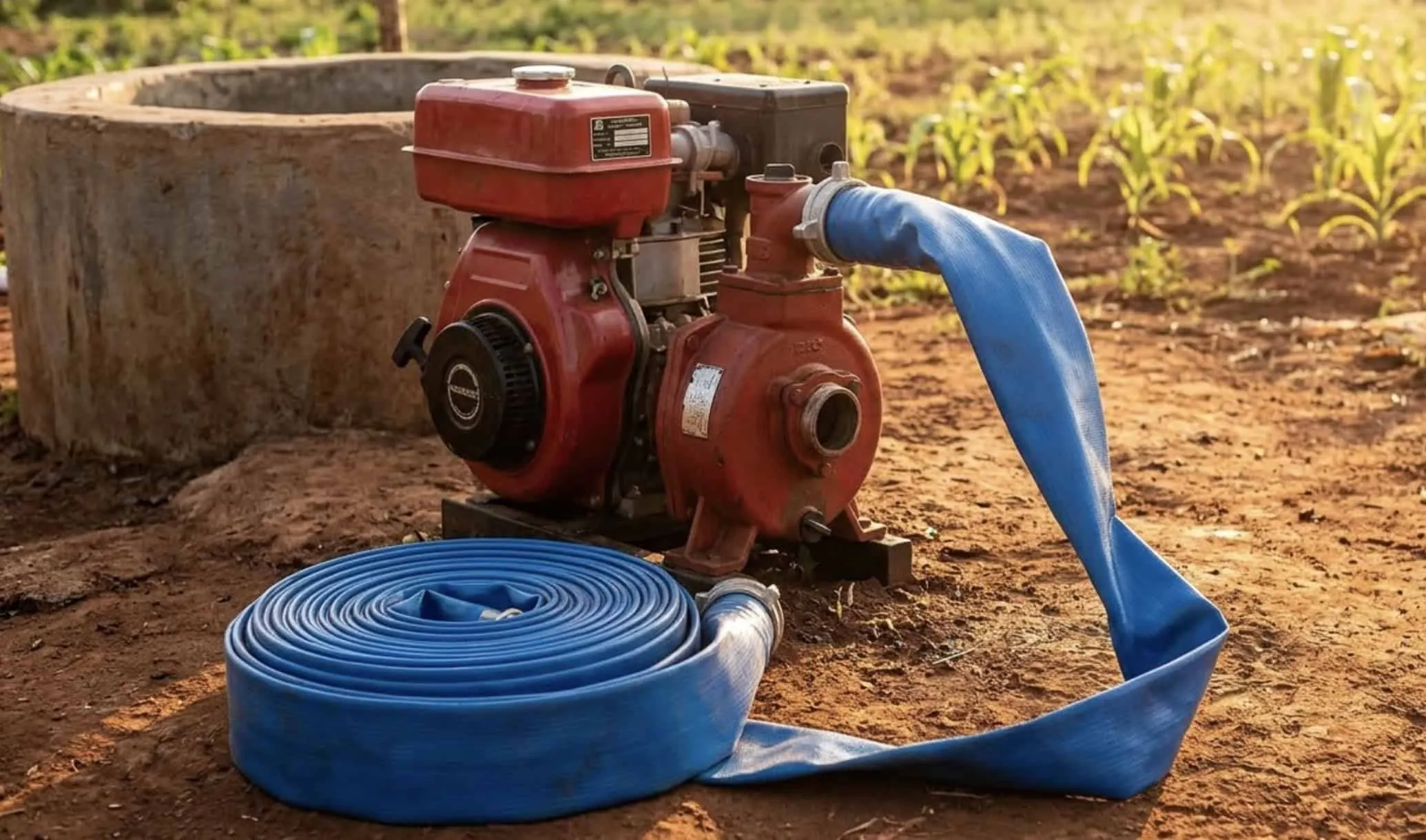
How to Calculate Layflat Hose Size for Your Pump
Choosing the wrong layflat hose diameter for your pump is one of the most common — and most costly — mistakes in agricultural irrigation and water transfer setups. An undersized hose creates excessive back-pressure, reduces flow rate, overworks the pump motor, and accelerates hose wear. An oversized hose wastes money and reduces water velocity to the point where sediment settles inside the hose.
The correct hose size is calculated from three inputs you already have: your pump's flow rate, the target flow velocity, and your hose run length. This guide walks through the full calculation — no engineering background required — and provides a quick-reference sizing table for the most common pump and field configurations.
Quick-reference size chart (water, 1.5–2.5 m/s target velocity)
| Hose ID | Max flow (m³/h) | Max flow (GPM) | Typical pump match |
|---|---|---|---|
| 1″ (25 mm) | 1.8 | 8 | Small transfer / garden pump |
| 1.5″ (38 mm) | 4.0 | 18 | 1–2 HP centrifugal |
| 2″ (51 mm) | 7.2 | 32 | 2–4 HP pump |
| 3″ (76 mm) | 16 | 70 | 4–8 HP pump |
| 4″ (102 mm) | 28 | 125 | 8–15 HP pump |
| 6″ (152 mm) | 63 | 280 | 15–40 HP pump |
| 8″ (203 mm) | 112 | 495 | 40+ HP pump |
Values based on 2.0 m/s average velocity. Highlighted row = calculator recommendation.
Step 1: Know Your Pump's Flow Rate
Every pump has a rated flow rate — stated in the product manual or stamped on the pump nameplate. The most common units are:
- m³/h (cubic meters per hour) — standard in China, Europe, Africa
- L/min (litres per minute) — common in agricultural equipment specs
- GPM (US gallons per minute) — used on American and some Australian pumps
If your pump manual only gives a range (e.g., "20–40 m³/h"), use the maximum rated output for sizing purposes. You want the hose to handle peak flow without excessive pressure loss.
If you do not know your pump's flow rate , measure it directly: time how long the pump takes to fill a container of known volume. A 200-litre drum filled in 4 minutes = 50 L/min = 3 m³/h.
Step 2: Understand Flow Velocity — The Core of Hose Sizing
The fundamental principle behind hose sizing is flow velocity — how fast the water moves through the hose bore. Flow velocity is calculated from the relationship between flow rate and pipe cross-sectional area:
V = Q / A
Where:
- V = velocity (m/s)
- Q = flow rate (m³/s)
- A = cross-sectional area of hose bore (m²) = π × (ID/2)²
You do not need to calculate this manually — the calculator above handles it. But understanding the target velocity range is essential for interpreting results:
| Velocity range | Assessment | Consequence |
|---|---|---|
| Below 0.8 m/s | Too slow | Sediment settles; hose clogs progressively |
| 0.8 – 1.0 m/s | Acceptable for clean water only | Low but workable |
| 1.0 – 3.0 m/s | Optimal for water discharge | Efficient flow, low friction loss |
| 2.0 – 3.5 m/s | Acceptable for dewatering | Higher friction; monitor pump load |
| Above 3.5 m/s | Too fast | Excessive friction loss; hose and coupling wear accelerates |
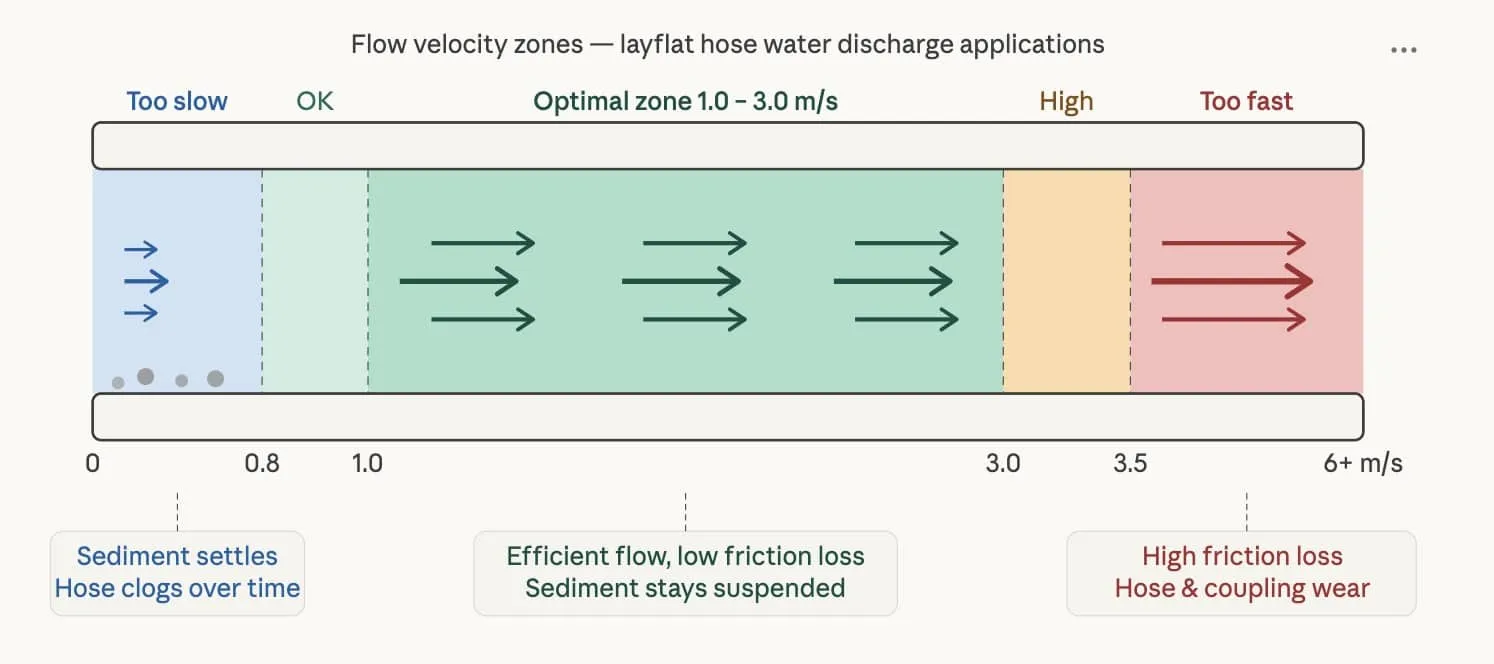 Flow Velocity Zone
For slurry or sediment-laden water: maintain a minimum of 1.5 m/s to prevent settlement inside the hose. Below this, suspended solids drop out and build up inside the bore — accelerating blockages and wear.
Step 3: Account for Friction Loss Over Hose Length
Friction loss is the pressure drop that occurs as water moves through the hose — caused by the water rubbing against the inner bore wall. The longer the hose and the higher the flow rate, the greater the friction loss.
Friction loss matters because it directly reduces the effective head (pressure) your pump delivers at the end of the hose. A pump rated for 30 metres of head may only deliver 18 metres of useful head if friction loss consumes 12 metres over a 200-metre hose run.
The standard formula used for water is the Hazen-Williams equation :
h_f = 10.67 × L × Q¹·⁸⁵² / (C¹·⁸⁵² × d⁴·⁸⁷)
Where:
- h_f = friction head loss (metres)
- L = hose length (metres)
- Q = flow rate (m³/s)
- C = Hazen-Williams roughness coefficient (use 140 for smooth PVC layflat hose)
- d = hose inner diameter (metres)
Again — the calculator handles this. The key practical rule: if friction loss exceeds 10 metres per 100 metres of hose, consider upsizing to the next diameter.
Step 4: Match Hose Diameter to Pump Outlet Size
As a baseline rule: the hose inner diameter should equal the pump outlet diameter. Reducing the hose below the outlet size always increases velocity and friction loss. Going one size larger than the outlet is acceptable and reduces friction — but adds cost and handling weight.
| Pump outlet | Minimum hose ID | Recommended hose ID |
|---|---|---|
| 1″ | 1″ (25 mm) | 1″ or 1.5″ |
| 1.5″ | 1.5″ (38 mm) | 1.5″ or 2″ |
| 2″ | 2″ (51 mm) | 2″ or 3″ |
| 3″ | 3″ (76 mm) | 3″ |
| 4″ | 4″ (102 mm) | 4″ or 6″ |
| 6″ | 6″ (152 mm) | 6″ |
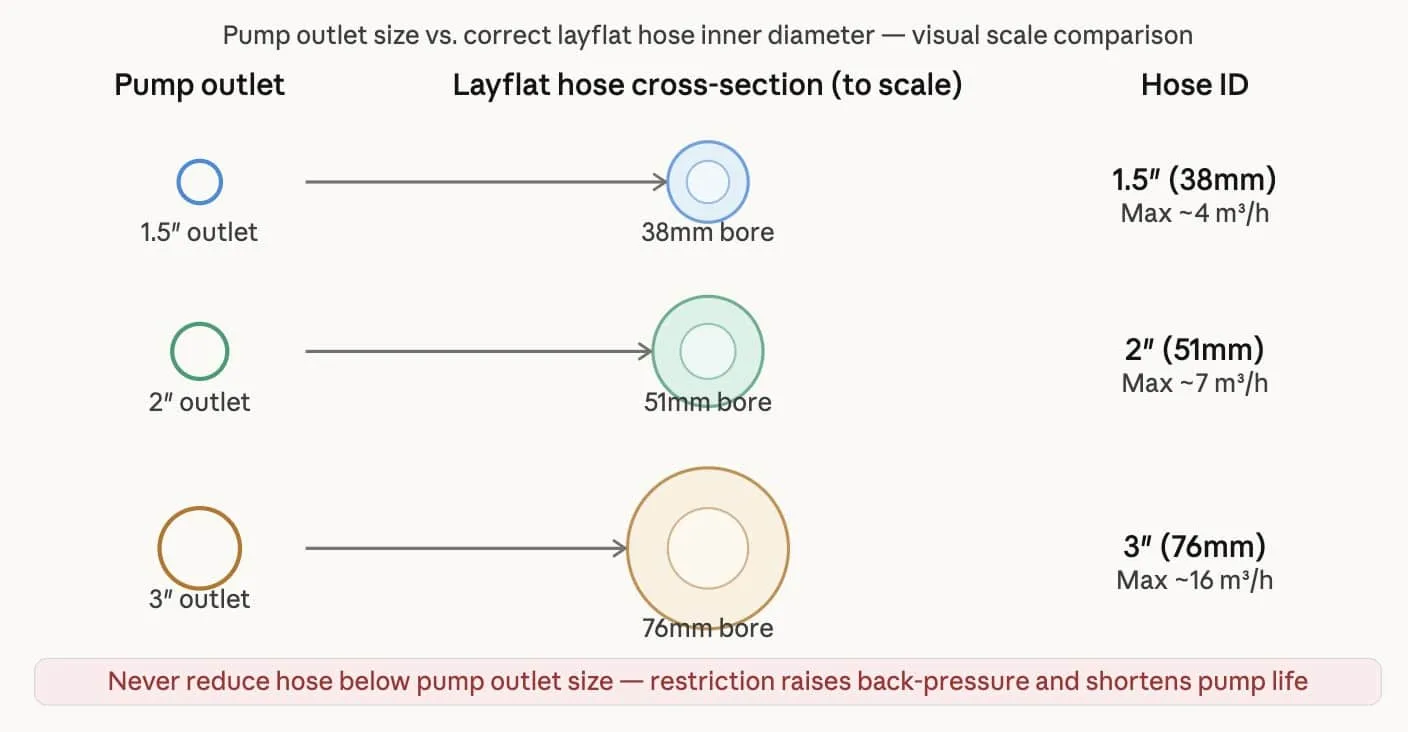 pump outlet vs hose size
Never reduce the hose below the pump outlet size. The pressure restriction created at the connection point will cause the pump to work against itself, reducing output and accelerating impeller wear.
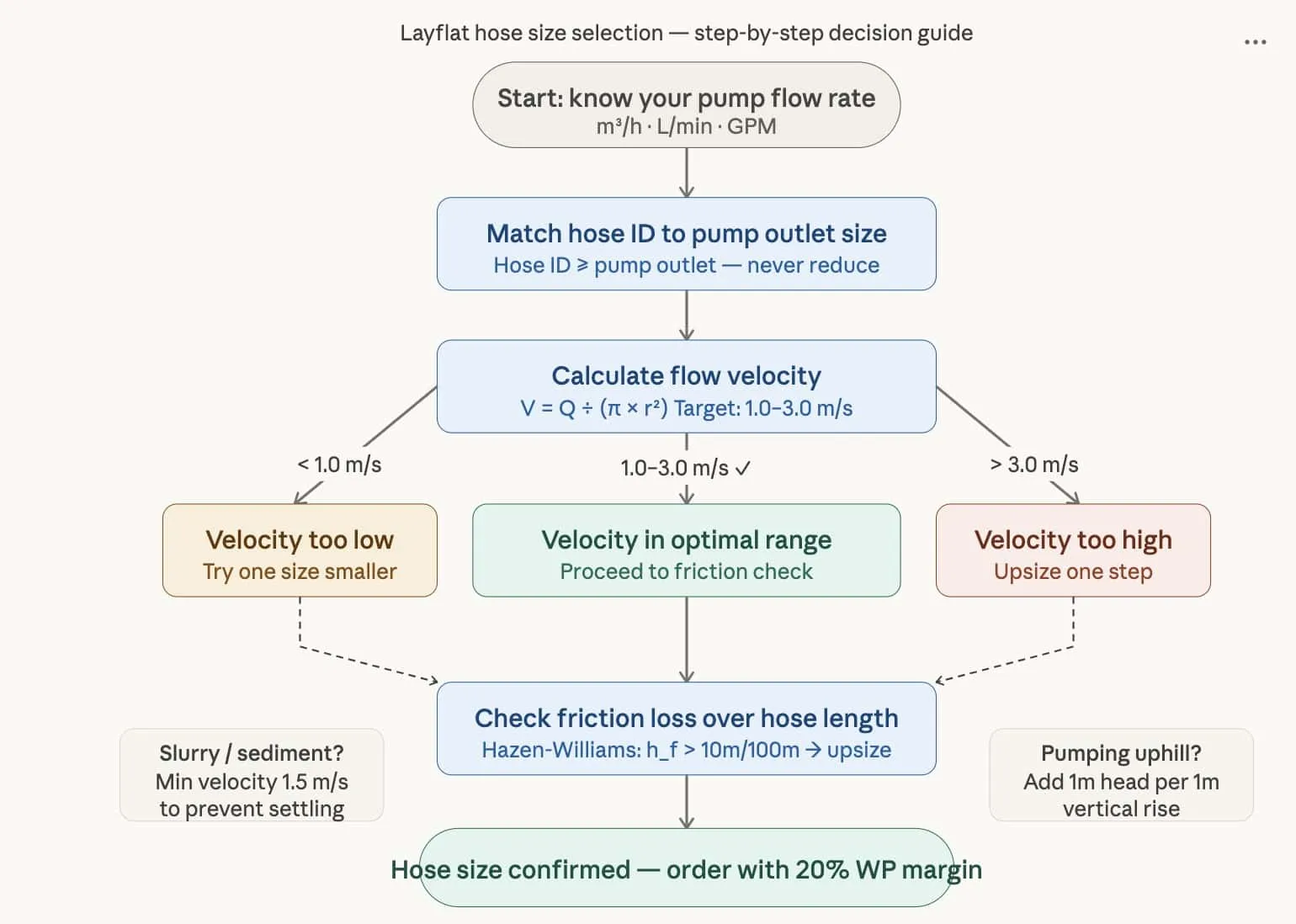 Hose Sizing Decision Flowchart
Step 5: Adjust for Elevation and Special Conditions
The calculator output gives you the minimum hose size for flat-ground horizontal discharge. In field conditions, two additional factors affect the final selection:
Elevation gain: If you are pumping uphill, every 1 metre of vertical rise consumes 1 metre of pump head. A pump with 20 metres of head discharging up a 10-metre incline only has 10 metres of head remaining for friction losses. In this scenario, upsizing the hose reduces friction losses and preserves more head for elevation work.
Multiple hose sections joined end-to-end: Each coupling joint adds a small amount of resistance (typically 0.2–0.5 metres equivalent head per connection). For runs with more than 10 joints, factor this in by adding 3–5 metres to your total friction loss estimate.
High-temperature conditions (Africa / Middle East): Water viscosity decreases slightly at higher temperatures, which marginally reduces friction loss — a minor benefit. More significantly, high ambient temperatures increase the internal pressure generated by trapped water when the pump stops. Always ensure your selected hose working pressure rating exceeds pump shutoff head + 20% safety margin.
Worked Example: Sizing for a 4-Inch Diesel Pump, 150 m Run
A common field scenario: a 4-inch diesel centrifugal pump rated at 40 m³/h, discharging across a flat field through 150 metres of layflat hose.
Step 1 — Flow rate: 40 m³/h
Step 2 — Try 4-inch (102 mm) hose:
- Area = π × (0.051)² = 0.00817 m²
- Flow in m³/s = 40 / 3600 = 0.0111 m³/s
- Velocity = 0.0111 / 0.00817 = 1.36 m/s ✓ (within 1.0–3.0 m/s optimal range)
Step 3 — Friction loss:
- h_f per 100 m ≈ 1.8 metres (using Hazen-Williams, C=140, d=0.102 m, Q=0.0111 m³/s)
- Total over 150 m ≈ 2.7 metres ✓ (well within acceptable range)
Result: 4-inch layflat hose is the correct match. Upsizing to 6-inch is unnecessary and would reduce velocity to 0.6 m/s — below the sediment-suspension threshold.
Common Sizing Mistakes and How to Avoid Them
Using the hose outer diameter instead of inner diameter. The sizing calculation uses inner diameter (ID) only. A "4-inch hose" with a 4 mm wall thickness has an ID of approximately 100 mm, not 102 mm — close enough for field selection, but verify the spec sheet for precision engineering applications.
Ignoring friction loss on long runs. A 2-inch hose handling 10 m³/h over 50 metres works well. The same hose extended to 300 metres loses nearly 25 metres of pump head to friction — potentially more than the pump's total rated head.
Selecting hose size based on pump horsepower alone. Horsepower tells you energy input, not flow rate. Two pumps with identical horsepower ratings can have very different flow rates depending on impeller design and head rating. Always size from flow rate (m³/h or GPM) , not horsepower.
Joining mismatched hose sizes. If you extend a 3-inch main line with a 2-inch secondary hose, the 2-inch section becomes the bottleneck. Size the entire run to the most restrictive section.
Frequently Asked Questions
Can I use a larger hose than my pump outlet size?
Yes — upsizing by one step (e.g., a 3-inch hose on a 2-inch pump outlet) reduces friction loss and can improve total system efficiency on long runs. Use a reducing adapter at the pump outlet connection. Do not upsize by more than one step, as velocity will drop below the sediment-suspension threshold.
What happens if my layflat hose is too small for my pump?
The pump works against the hose restriction, reducing actual output below rated flow rate, increasing motor temperature, and shortening pump life. The hose itself will experience higher internal pressure at the pump-end coupling — increasing the risk of coupling leaks and hose burst.
How do I size layflat hose for a submersible pump?
Submersible pumps discharge upward through a riser pipe before connecting to the surface layflat hose. Size the layflat hose to match the pump's rated surface flow rate (which is lower than the theoretical maximum due to the lift head). The submersible pump's data sheet will specify flow rate at different total head values — use the value corresponding to your actual total head (depth + friction losses).
Does hose material affect sizing?
Slightly. The Hazen-Williams coefficient (C) varies by material: smooth PVC layflat hose uses C=140–150, rubber layflat hose uses C=130–140. The difference is small for field selection purposes — use C=140 for both in standard calculations.
My pump is rated in HP or kW, not flow rate. How do I find the flow rate?
Check the pump's performance curve in the manual. All centrifugal pumps have a curve showing flow rate vs. head — find the point corresponding to your system head (discharge height + friction losses) and read off the flow rate. If no manual is available, contact the pump manufacturer with the model number.
| Hose ID | Max flow (m³/h) | Max flow (GPM) | Typical pump match |
|---|---|---|---|
| 1″ (25 mm) | 1.8 | 8 | Irrigation / water transfer / 1HP |
| 1.5″ (38 mm) | 4.0 | 18 | 1–2 HP |
| 2″ (51 mm) | 7.2 | 32 | 2–4 HP |
| 3″ (76 mm) | 16 | 70 | 4–8 HP |
| 4″ (102 mm) | 28 | 125 | 8–15 HP |
| 6″ (152 mm) | 63 | 280 | 15–40 HP |
| 8″ (203 mm) | 112 | 495 | 40+ HP |