How to choose camlock couplings for the flexible hoses?
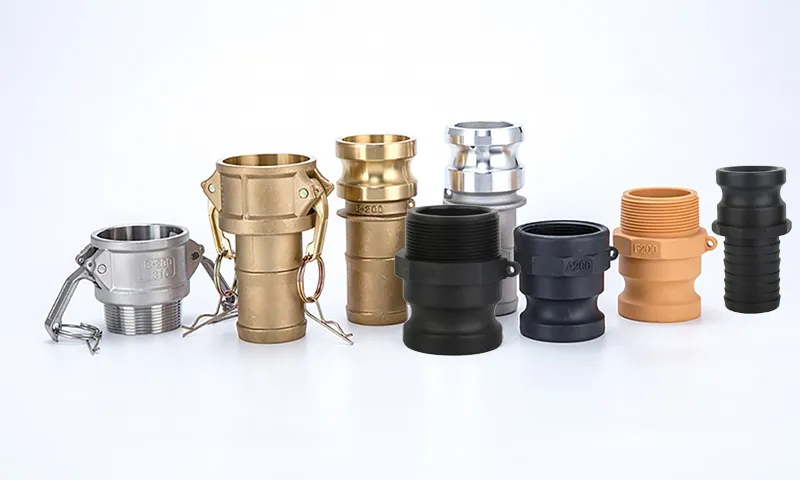
Camlock couplings (cam and groove fittings) look simple, but ordering the wrong type, material, or size causes leaks, system downtime, and safety risks. This guide walks through the six decisions every buyer needs to make — in the right order — before placing an order.
If you already know what you need and want to see Sunhose's full range, view our Camlock Couplings product page for specifications, pricing, and a quote request form.
What Is a Camlock Coupling?
A camlock coupling (also called a cam and groove coupling) is a quick-connect fitting that joins two hoses or pipes without tools. The male adapter inserts into the female coupler, and two cam arms lock the connection in under five seconds. To disconnect, flip the cam arms open. They are the most widely used hose coupling in the world because they require no threading, work in dirty environments, and allow fast hose changes — critical for agriculture, petroleum delivery, chemical transfer, and construction dewatering.
The 6-Step Selection Framework (STAMPS)
Use the STAMPS checklist — six factors that fully define the camlock coupling you need. Work through them in order, because each decision narrows the next one.
Step 1: Size — Match Your Hose Inner Diameter
The camlock size must match the inner diameter (ID) of your hose or pipe. Do not measure the outside of the hose — measure the opening.
| Hose Inner Diameter | Camlock Size | Common Application |
|---|---|---|
| 25 mm (1″) | 1″ | Small pumps, spray hose, garden irrigation |
| 38 mm (1½″) | 1½″ | Suction hose, small pump discharge |
| 50 mm (2″) | 2″ | Most common — standard irrigation, dewatering |
| 75 mm (3″) | 3″ | Medium-volume water transfer, construction |
| 100 mm (4″) | 4″ | High-volume discharge, mining, large farms |
| 150 mm (6″) | 6″ | Large-diameter dewatering, industrial plants |
Step 2: Type — Choose the Right Configuration
Eight standard types cover every connection scenario. The key decision: does your connection point have a thread or a hose barb?
| Type | Description | When to use it |
|---|---|---|
| A | Male adapter × female thread | Your pipe/pump has a female-threaded outlet |
| B | Female coupler × male thread | Your pipe/tank has a male-threaded outlet |
| C | Female coupler × hose shank | Attaching directly to hose end (discharge side) — most popular for layflat hose |
| D | Female coupler × female thread | Joining two male-threaded pipe ends |
| E | Male adapter × hose shank | Attaching to hose end (supply/pump side) — pairs with Type C |
| F | Male adapter × male thread | Joining two female-threaded pipe ends |
| DC | Dust cap | Protecting a female coupler during storage or transport |
| DP | Dust plug | Protecting a male adapter during storage or transport |
Step 3: Material — Match to Your Fluid
Material selection is the most critical decision and the most common source of errors. The wrong material will corrode, crack, or contaminate your product.
| Material | Best for | Avoid when | Price level |
|---|---|---|---|
| Aluminum | Water, petroleum, fuel, general industrial use, agriculture | Strong acids, alkalis, food-grade, seawater | Low–medium |
| Stainless Steel 316 | Corrosive chemicals, food & beverage, pharmaceutical, marine, high temperature | Budget-sensitive non-critical applications | High |
| Polypropylene (PP) | Fertilizers, pesticides, acids, alkalis, low-pressure chemical service | Compressed air or gas, high temperature (>70°C), high pressure (>100 psi) | Low |
| Brass | Water, petroleum, diesel, marine environments | Ammonia, certain acids | Medium |
Step 4: Pressure — Check Your System's Maximum
Camlock pressure ratings vary by material and size. Check that your chosen coupling's rating exceeds your system's maximum working pressure — including any pressure spikes.
| Material | ½″–2″ max pressure | 2½″–6″ max pressure |
|---|---|---|
| Aluminum | 150 psi (10.3 bar) | 75 psi (5.2 bar) |
| Stainless Steel 316 | 150 psi (10.3 bar) | 75 psi (5.2 bar) |
| Polypropylene | 50–100 psi (size-dep.) | Not available above 4″ |
Step 5: Gasket Material — Match to Your Fluid and Temperature
The gasket creates the pressure seal between the two coupling halves. It must be chemically compatible with the fluid being transferred.
| Gasket | Temp range | Best for |
|---|---|---|
| Buna-N (NBR) | -40°F to 212°F | Standard choice — water, petroleum, oils, general purpose |
| EPDM | -60°F to 225°F | Acids, alkalis, fertilizers, ozone. Standard on polypropylene camlocks |
| Viton (FKM) | -20°F to 400°F | High-temperature applications, solvents, fuels, aromatic hydrocarbons |
| Silicone | -60°F to 275°F | Food and beverage, pharmaceutical, dairy |
| PTFE (Teflon) | -40°F to 250°F | Aggressive acids and highly corrosive chemicals |
Step 6: Thread Standard — NPT or BSP?
This is one of the most common ordering errors. NPT and BSP threads look similar but are not compatible — attempting to connect them causes leaks and thread damage.
| Thread Standard | Where it's used | How to identify |
|---|---|---|
| NPT (National Pipe Taper) | United States, Canada, Mexico, Japan | 60° thread angle; tapers to seal on threads |
| BSP / BSPT (British Standard Pipe) | UK, Australia, Middle East, most of Asia, Africa | 55° thread angle; requires a face seal or PTFE tape |
Quick Decision Table: Which Camlock Should You Order?
Use this table to quickly narrow down your specification based on your most common use cases:
| Application | Recommended Type | Material | Gasket | Thread |
|---|---|---|---|---|
| Agricultural irrigation (water) | C + E | Aluminum | Buna-N | BSP (Asia/Africa/ME) or NPT (Americas) |
| Fertilizer / pesticide sprayer | C + E | Polypropylene | EPDM | BSP or NPT |
| Fuel / diesel delivery truck | B or A | Aluminum or Brass | Buna-N | NPT or BSP |
| Chemical transfer (mild acids) | C + E | SS316 | Viton | BSP or NPT |
| Food / beverage processing | C + E or B | SS316 | Silicone | BSP or NPT |
| Mining / construction dewatering | C + E | Aluminum | Buna-N | BSP |
| IBC container connection | A or D | PP or SS316 | EPDM or Viton | BSP 2″ |
5 Common Camlock Selection Mistakes (and How to Avoid Them)
1. Mixing material types in the same connection
Never connect a PP coupler to an aluminum adapter, or an aluminum coupler to a SS adapter. Different materials have different tensile strengths — the weaker material fails first under pressure. Always use the same material on both halves of the connection.
2. Ordering the wrong thread standard
NPT and BSP threads are not interchangeable. A cross-threaded camlock connection will not seal and may damage both fittings. Confirm your pump's thread standard before ordering.
3. Ignoring temperature effects on pressure ratings
Pressure ratings are stated at ambient temperature (70°F / 21°C). In hot climates, or when transferring hot fluids, the effective pressure rating drops significantly — especially for polypropylene, which loses 40% of its rated pressure at 70°C.
4. Using polypropylene for compressed air or gas
Polypropylene camlock couplings are not suitable for compressed air or gas under any circumstances. Under pressure, a sudden failure of PP fittings in pneumatic service can cause serious injury. Use aluminum or stainless steel for any gas application.
5. Sizing by hose outside diameter instead of inside diameter
Camlock size is determined by hose inner diameter (ID) — not outside diameter (OD). A 2″ hose may have an OD of 58–65mm depending on wall thickness. Always measure the opening of the hose, not the outer shell.
Order Camlock Couplings from Sunhose
Sunhose supplies all eight standard camlock types (A–F, DC, DP) in aluminum, stainless steel 316, and glass-reinforced polypropylene. Sizes ½″ to 6″, NPT and BSP threads. We also supply complete hose assemblies with couplings pre-fitted — ready to connect on arrival at your warehouse. → View full Camlock Coupling specifications, pressure tables, and request a quote To place an order or request pricing, contact us directly:
- Email: [email protected]
- WhatsApp: +86 180 5604 4070
- FOB China · 12-hour quote response · ISO 9001 certified · 25 years export experience
Different Materials Camlock Coupling
| Material | Characteristic | Advantage | Disadvantage | Application |
|---|---|---|---|---|
| Aluminum Alloy | low density, high intensity, good plasticity, electrical and thermal conductivity, anti-corrosion | low cost | relative to stainless steel material, corrosion resistance is poor, easy mildew and oxidation | fresh water, oil-water mixtures |
| Stainless Steel | anti-corrosion, formability, compatibility, durability | clean inner wall, temperature resistance, high strength | high cost | acid, alkali and highly corrosive areas |
| Polypropylene | low density, anti-acid, anti-alkali, anti-organic solution, chemical stability, anti-aging | good leakproofness, light weight, low price, easy operation | low strength, easy to deform | acid, alkali environment, chemical industry liquids transmission, agriculture irrigation |
| Nylon | heat resistance, higher density than PP, resistance to changing humidity, dimensional stability | good leakproofness, light weight, low price, easy operation | low strength, easy to deform | acid, alkali environment, chemical industry liquids transmission, agriculture irrigation |
| Brass | electrical conductivity, seawater resistant | easy to assemble | high cost | salty water and any media except for acid and alkali, shipbuilding industry, deep well operations |
Aluminum Alloy Camlock Couplings
According to the processing method, aluminum alloy can be divided into deformation aluminum alloy and casting aluminum alloy. Aluminum alloy camlock couplings generally use the casting processing method. By chemical composition, casting aluminum alloy includes aluminum-silicon alloy, aluminum-copper alloy, aluminum-magnesium alloy, Al-Zn alloy, and rare earth aluminum alloy.
- Characteristic: Low density, high intensity. Can be processed into various profiles with good plasticity. Excellent electrical conductivity, thermal conductivity, and corrosion resistance.
- Advantage: Low cost.
- Disadvantage: Relative to stainless steel, corrosion resistance is poor — easy to mildew and oxidize.
- Application: Fresh water and oil-water mixtures.
Stainless Steel Camlock Couplings
Stainless steel resists rust through the formation of a chromium-rich oxidation film. Camlock coupling materials include SS 304, SS 316, and SS 316L — SS 316L offers the best performance at the highest price.
- Characteristic: Excellent corrosion resistance, formability, compatibility. Strong enough across a wide temperature range.
- Advantage: Clean inner wall prevents impurity buildup, bacteria, and media contamination. High strength resists leakage from external forces. Safe operation from -30°C to 230°C.
- Disadvantage: High cost.
- Application: Highly corrosive areas, acid and alkali media. Heavy industry, light industry, daily necessities, construction, and decoration.
- Applicable environment: Pressure up to 16 kg; temperature -30°C to +230°C; media include gasoline, kerosene, hydraulic oil, fuel oil, water, brine, acidic and alkaline liquids. Thread types: NPT, BSPT, BSP. Sealing materials: NBR (most popular), Viton (most expensive), EPDM.
Polypropylene & Nylon (Plastic) Camlock Couplings
Plastic camlock couplings (PP and Nylon) offer a lightweight, low-cost alternative with good chemical resistance. Plastic Camlock couplings use high-quality NBR seals for safe, reliable connections. Any B, C, D, or DC type can combine with any E, F, A, or DP type of the same specification.
- PP characteristic: Low density. Anti-acid, anti-alkali, anti-organic solutions. Excellent electrical insulation and chemical stability. High-temperature resistance, anti-aging. Smooth surface.
- Nylon characteristic: Higher density than PP. High heat resistance. Excellent rigidity and toughness. Resistance to changing humidity. Excellent dimensional stability. Smooth surface.
- Advantage: Low price, lightweight. Simple structure, easy operation. Good seal.
- Disadvantage: Low intensity, easy to deform.
- Application: Agriculture irrigation, liquid transmission (water, oil, gas, corrosive liquids), chemical industry.
Brass Camlock Couplings
- Characteristic: Good electrical conductivity. Seawater resistant.
- Advantage: Easy to assemble.
- Disadvantage: High cost.
- Application: Salty water and any media except acid and alkali. Deep well operations, shipbuilding industry.
Camlock Coupling Types Reference
Camlock couplings are identified by their type designations:
| Type | Description |
|---|---|
| Type A | Plug with Female Thread |
| Type B | Coupler with Male Thread |
| Type C | Coupler with Hose Tail |
| Type D | Coupler with Female Thread |
| Type E | Plug with Hose Tail |
| Type F | Plug with Male Thread |
| Type DC | Dust Cap for plugs |
| Type DP | Dust Plug for Couplers |
The cam and groove assembly consists of a male groove adapter and a female coupler. To connect and disconnect:
- Extend the handles on the coupler outwards and place the correct size male adapter into the female coupler
- Close both handles at the same time until the two halves are firmly fixed together
- Closing both handles at the same time ensures that the grooved adapter is pulled down evenly onto the seal making a leakproof assembly for the safe transfer of liquids
- Reverse the process to disconnect the fitting making sure before doing so that the hose assembly has been de-pressurized.