OEM Layflat Hose: A Private-Label Buyer's Guide to MOQ, Printing and Sample Approval
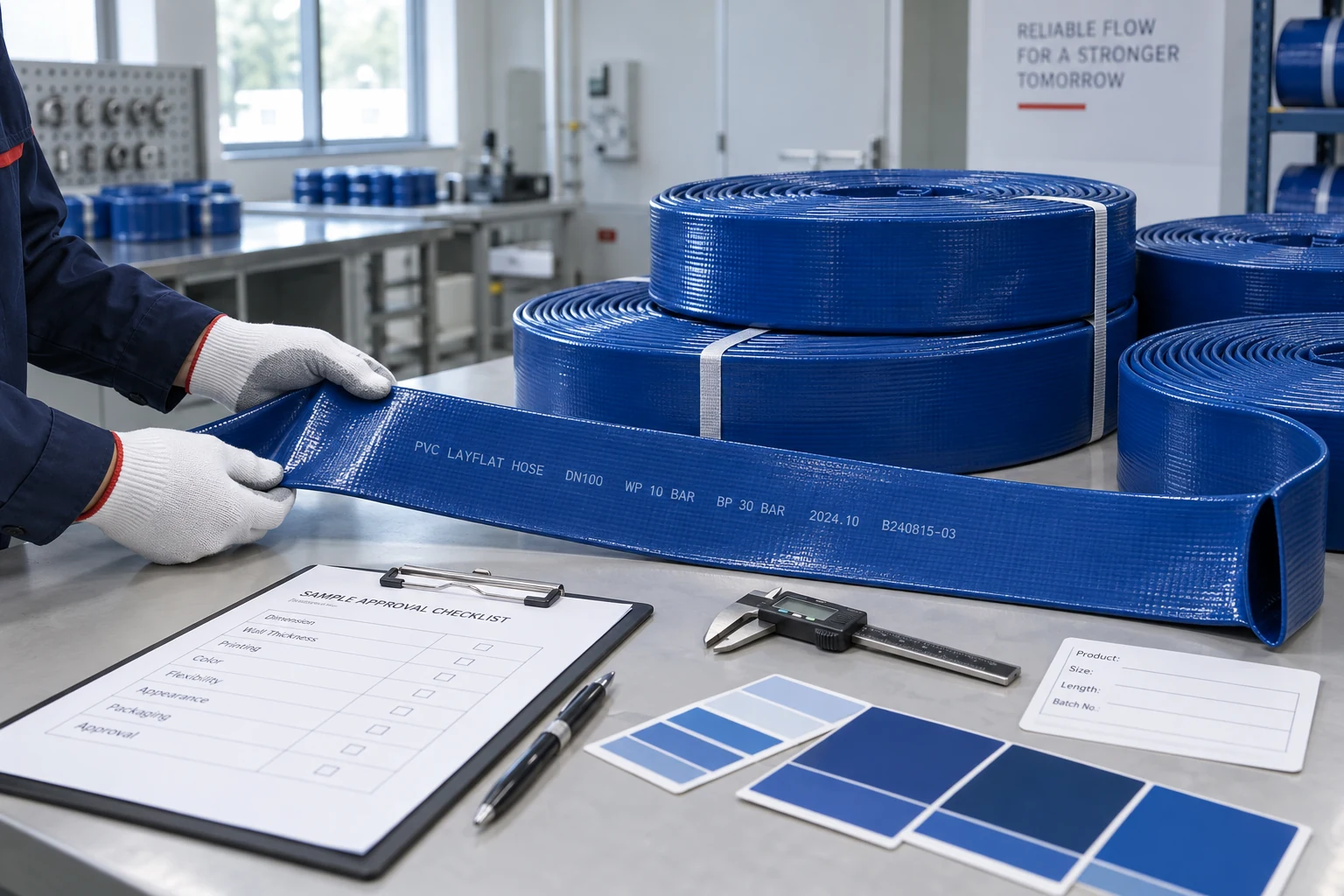
Private-label layflat hose is easy to describe and surprisingly easy to mis-specify. A buyer may ask for “a blue 4-inch hose with our logo,” while the factory still needs to know the construction, wall thickness or weight basis, working-pressure test conditions, print repeat, roll length, packaging unit and acceptance criteria. If those details remain open when production starts, the logo can be correct while the delivered product is still wrong.
This guide gives distributors, wholesalers and OEM product managers a controlled path from the first RFQ to an approved sample. It also explains which decisions affect MOQ, why a signed artwork proof is not the same as a physical approval sample, and what to preserve as the reference for repeat orders.
Need a quotation? Send Sunhose your application, size range, pressure requirement, annual volume, destination market and print artwork. We will confirm feasibility, item-level MOQ, sampling route and lead time for your exact program. Submit your OEM layflat hose specification.
First decide whether you need a standard product or a custom construction
An OEM order can mean several different levels of customization. They do not carry the same development work or production commitment.
| Customization level | Typical decisions | What must be confirmed |
|---|---|---|
| Private label on a standard hose | Brand name, specification line, print color, roll label | Print area, repeat, artwork proof, item-level MOQ |
| Standard construction with commercial changes | Custom roll length, color, carton or woven bag, barcode | Packing dimensions, units per package, label data, pallet requirement |
| Modified performance specification | Diameter, wall/weight target, reinforcement, working pressure, temperature or UV requirement | Test method, tolerances, sample plan and acceptance criteria |
| New construction | Material system or performance outside the current range | Technical review, development sample, validation scope and commercial approval |
Start with the standard PVC layflat hose range whenever it meets the application. This reduces development variables and makes repeat-order control simpler. Use a modified or new construction only when a documented customer requirement justifies it.
Freeze the technical specification before discussing the logo
Printing is visible, but construction determines whether the hose performs. Your RFQ should identify the product independently of its branding.
Minimum technical fields for an OEM layflat hose RFQ
| RFQ field | What the buyer should state | Why it matters |
|---|---|---|
| Application and conveyed media | Irrigation water, dewatering, construction discharge or another defined service | Guides material and pressure review |
| Inside diameter | Metric and/or inch designation, plus required tolerance if critical | Avoids nominal-size ambiguity |
| Construction | PVC layflat type, reinforcement and any required cover properties | Defines the product family |
| Wall thickness or unit weight | Target and acceptable tolerance; state how it will be measured | Prevents two visually similar hoses being quoted as equivalent |
| Working pressure | Required rating and test temperature | Pressure ratings depend on conditions |
| Proof/burst requirement | Required test method, hold time and acceptance rule | Makes supplier test data comparable |
| Service temperature | Minimum and maximum expected hose temperature | PVC flexibility and pressure capability change with temperature |
| Roll length | Nominal length and permitted tolerance | Affects packing, labeling and landed cost |
| Order mix | Quantity by diameter, pressure class, color and print design | MOQ normally applies to the actual SKU combination |
| Destination market | Country and any required marking or documentation | Controls units, language, compliance statements and labels |
Do not use catalogue working pressure as a substitute for your system review. Pump shut-off head, surges, temperature, couplings and installation all affect the completed assembly. The quotation and approval sample should state the agreed test conditions, rather than showing a pressure number without context.
Specify the print line as controlled product data
A useful hose print line does more than display a logo. It helps distributors identify the SKU, prevents warehouse mix-ups and supports batch traceability.
Define each element in order:
- Brand or private-label name. Supply vector artwork when a graphic mark is required. Do not rely on a screenshot.
- Product identification. Include the hose family or agreed model code.
- Size. State whether the market expects inches, millimetres or both.
- Pressure marking. Use the exact approved value and unit. Do not add a certification mark unless its use is authorized for that product.
- Batch or date code. Agree on the format and whether it changes by production lot.
- Country-of-origin or compliance text. Confirm legal and customer requirements for the destination market.
- Print repeat and orientation. Define the maximum unprinted distance and the direction in which text reads when the hose is deployed.
The artwork proof should show the complete line, spelling, capitalization, units, order, print color and repeat. Record the proof with a revision number such as ART-03; “latest artwork” is not an adequate production instruction.
Treat color as a measurable approval item
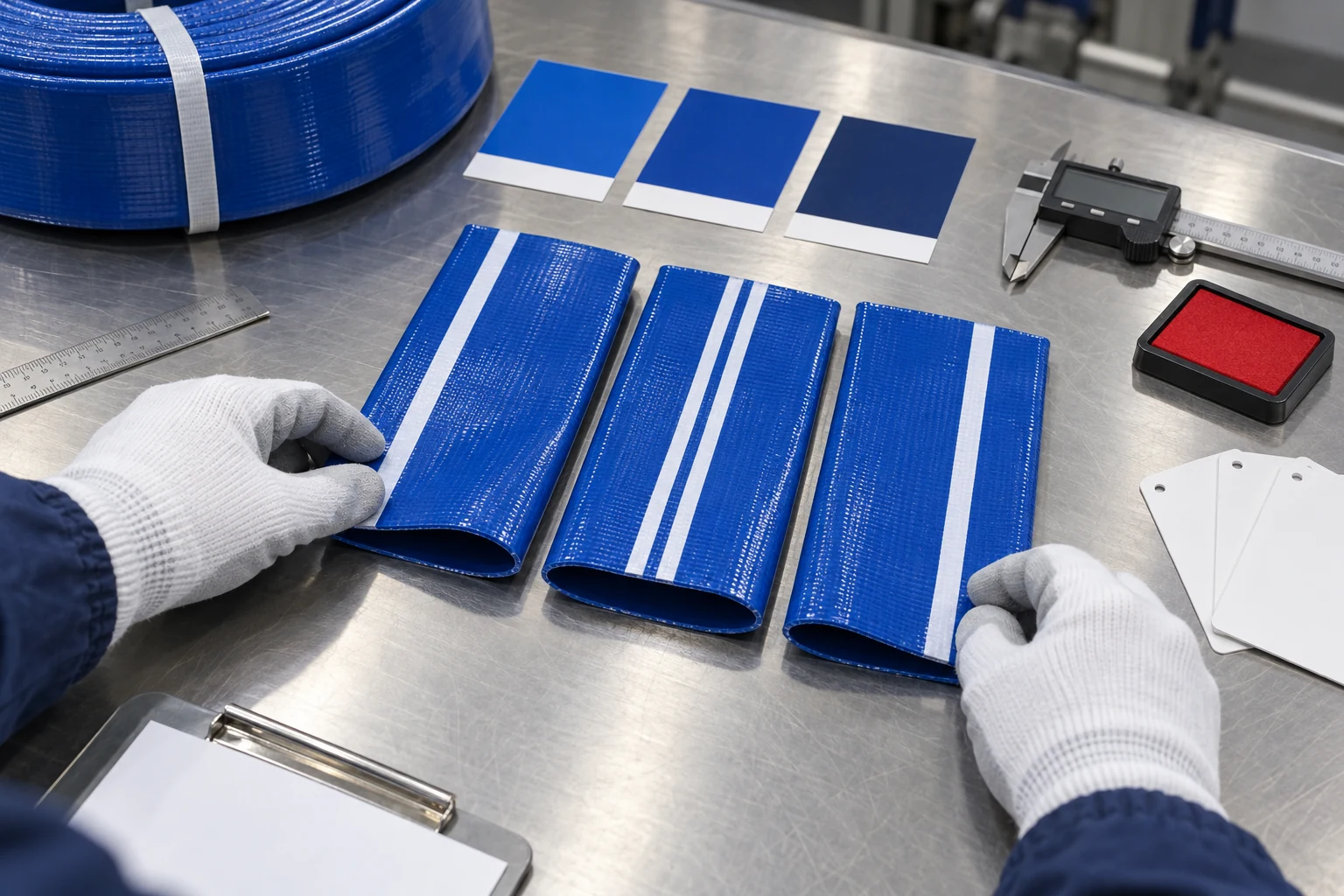
“Blue,” “dark blue” and a screen color are not reliable manufacturing references. Screens, lighting and PVC surface texture change how a color appears.
For a private-label program, use one or more of these controls:
- a named color reference or physical swatch agreed by both parties;
- a retained hose sample, because gloss and reinforcement can alter the visual result;
- an acceptable visual range under defined lighting;
- an instrument value and tolerance when color matching is commercially critical.
Also decide whether color consistency is judged within one roll, within one batch or against the retained approval sample across repeat orders. If outdoor appearance matters, state the UV or weathering requirement separately; matching the initial color does not by itself establish long-term color retention.
Understand what actually drives MOQ
There is no responsible universal answer to “What is the MOQ for custom hose printing?” MOQ depends on the product and the number of changeovers required.
The main drivers are:
- hose diameter and pressure construction;
- compound and color change;
- print plate, ink and artwork change;
- roll length and packaging format;
- the number of SKUs split across the total order;
- material purchasing and production scheduling;
- sample type: stock sample, printed sample or new-construction sample.
Ask for MOQ by SKU, not only by purchase order. For example, one container can still contain several low-volume combinations of diameter × pressure × color × artwork. The factory may be able to consolidate some variables, but that must be confirmed during quotation.
Your commercial sheet should separate:
| Commercial item | Confirmation required |
|---|---|
| Production MOQ | Quantity for each diameter/construction/color/artwork combination |
| Sample charge | Stock sample, printed sample or development sample cost |
| Artwork or tooling charge | One-time or repeat charge, if applicable |
| Sample lead time | Starts after which input or payment is received |
| Production lead time | Starts after sample/artwork approval, deposit or another agreed milestone |
| Freight | Sample courier and bulk-shipment terms |
MOQ, sampling cost and lead time should come from the sales quotation for the final specification. Avoid copying figures from another product or an earlier season into the purchase order.
Use a gated process from RFQ to mass production
The process below creates a written decision at each handoff.
| Gate | Supplier output | Buyer decision |
|---|---|---|
| 1. RFQ review | Clarified specification, open-question list | Confirm application and all required fields |
| 2. Feasibility and quotation | Product route, item-level MOQ, sample route, price and lead-time basis | Select the commercial/technical option |
| 3. Artwork proof | Dimensioned print layout and packaging-label proof with revision ID | Approve wording, units, position, repeat and color |
| 4. Physical sample | Representative hose and agreed test/inspection records | Accept, reject or request one controlled revision |
| 5. Golden-sample release | Signed approval record and reference-sample identity | Authorize production against the approved revision |
| 6. Production and inspection | Batch identification and inspection/test results | Review required release documents |
| 7. Packing and shipment | Final labels, quantities and shipping marks | Approve shipment documents against the PO |
Do not collapse Gate 3 and Gate 4. A digital artwork proof confirms content and layout; it does not demonstrate actual ink adhesion, contrast, hose color, surface appearance or product dimensions.
Build a useful golden-sample approval record
The “golden sample” is the physical and documentary reference for production. Approval should identify exactly what was accepted rather than relying on a signature beside a photograph.
Check and record:
- buyer, supplier and project/SKU code;
- sample number and artwork revision;
- hose type, diameter, construction and roll length;
- measured dimensions or unit weight, with the agreed tolerances;
- agreed pressure-test record and conditions;
- hose color reference and visual acceptance;
- print wording, spelling, units, alignment, repeat and adhesion;
- label, barcode, bag/carton and shipping-mark proof;
- deviations that are accepted only for the sample or for production;
- approval name, date and decision: approved, approved with conditions, or rejected;
- retained samples held by both buyer and supplier.
Download the OEM layflat hose sample approval checklist (CSV). Add your company-specific tolerances and legal requirements before issuing it with an RFQ or purchase order.
Control revisions after approval
A common repeat-order failure starts with an apparently small change: a new phone number in the print line, a different carton label, a revised wall weight or a substitute color. If the change is not tied to a new revision, the factory, buyer and packaging supplier may work from different files.
Use one revision register covering:
- technical specification;
- print artwork;
- color reference;
- packaging and label files;
- inspection plan;
- golden-sample identifier.
Every approved change should state its effective purchase order or production lot. Superseded artwork should be marked obsolete and removed from the active production package. For repeat orders, the PO should reference the approved specification revision and ask the supplier to confirm whether any material, process or source has changed.
Choose medium-duty or heavy-duty construction by application
Private labeling does not turn one construction into another. Select the base hose first.
The medium-duty layflat discharge hose is suited to applications where mobility, compact storage and economical water transfer are the main priorities. The heavy-duty layflat water hose is the better starting point where the specified pressure class, handling conditions or service severity requires a more robust construction.
Ask for comparable data under the same test conditions. A heavier hose is not automatically correct for every program, and a lower-priced hose is not equivalent merely because its nominal diameter and color match.
Approve packaging as part of the product
Overseas distributors need packaging that survives handling and remains identifiable at the destination warehouse. Include the following in the approval set:
- roll length and winding method;
- strap, bag, woven wrap, carton or pallet requirement;
- units per carton or pallet;
- gross/net weight fields and package dimensions;
- SKU, barcode and destination-language label;
- batch or production code;
- shipping marks and country-of-origin wording;
- any restrictions on staples, exposed metal or mixed SKUs.
Request a label proof before production and, when packaging is custom, a packed-sample photograph or physical sample. Reconcile the final packing list with the approved SKU matrix before shipment.
Copy-ready OEM RFQ example
Use this structure in your first inquiry:
Application: Agricultural irrigation water discharge
Destination market: [country]
Hose: PVC layflat, [diameter list], [working pressure requirement and test conditions]
Construction control: [wall thickness or unit-weight target and tolerance]
Temperature/service: [minimum, maximum, exposure details]
Rolls: [length and tolerance]
Color: [reference and acceptable range]
Printing: [attach vector artwork; state text, units, color, repeat and batch-code format]
Packaging: [bag/carton/pallet, barcode, label language and shipping marks]
Quantity: [meters by SKU] and [annual forecast]
Approval required: Artwork proof, physical sample, inspection/test record and retained golden sample
Please quote: Item-level MOQ, sample cost, tooling/artwork cost, sample lead time, production lead time and Incoterm
Frequently asked questions
Can our logo be printed on layflat hose?
Yes, subject to artwork, print-space and order feasibility review. Provide vector artwork and the complete marking line. The final quotation should confirm item-level MOQ, any setup cost and the approval route.
Is an artwork PDF enough to approve production?
It is enough to approve wording and layout when the proof is properly dimensioned. A physical sample is still needed when you must validate actual print appearance, ink adhesion, hose color, dimensions or a new construction.
Should the approved sample be returned to the factory?
The safest arrangement is for both buyer and supplier to retain identified samples from the same approved run, together with photographs and the signed approval record. Record how long each party must retain it.
Can several diameters share one custom-printing MOQ?
Sometimes, but do not assume so. Diameter, construction, color, artwork and packaging can create separate production SKUs. Ask the supplier to show MOQ against every line in the order matrix.
What should be checked again on a repeat order?
Reference the approved specification and artwork revisions, confirm that no controlled input has changed, and repeat the agreed incoming or pre-shipment checks. A previous approval does not authorize an undocumented material or process change.
Request an OEM layflat hose quotation
Sunhose supplies PVC layflat hose for distributor, wholesale and OEM programs. To receive a useful quotation, send your size and pressure matrix, application, destination country, quantity by SKU, color reference, roll length, packaging requirement and print artwork.
Submit your specification and printing artwork for an OEM quotation. Our sales team will confirm the applicable MOQ, sample route, approval steps and lead time for the requested configuration.