PVC & Layflat Hose HS Codes, Import Duty and Customs Clearance: An Importer's Guide
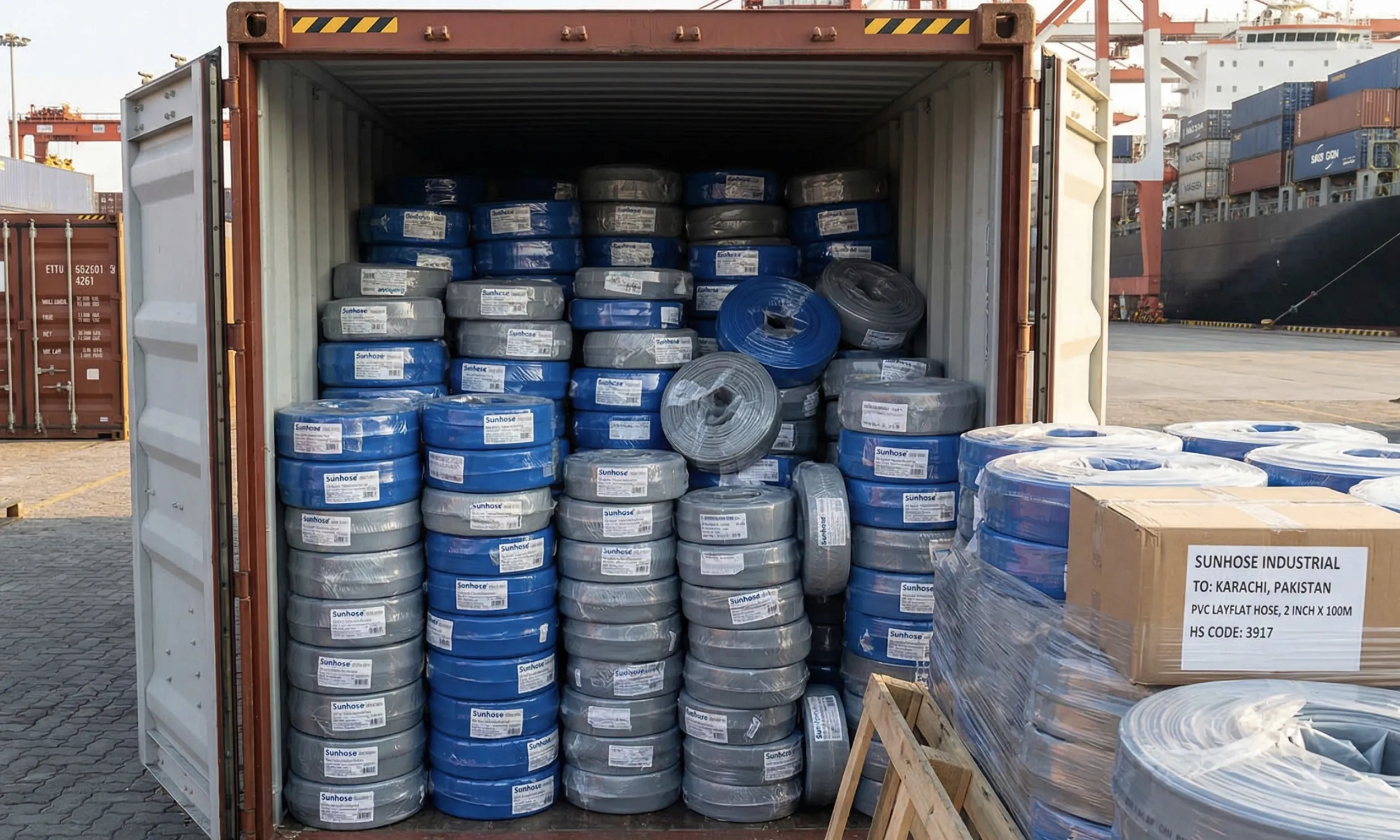
Every few months we get the same phone call. A customer's container is sitting at their port, customs has queried the classification, and the storage charges are running. Nine times out of ten the goods are fine — the paperwork is the problem. The invoice says "plastic pipe" when the container holds reinforced hose, or one line item called "hose set" turns out to contain hose, aluminum couplings, and steel clamps, which are three different HS codes in every customs territory on earth.
After 25 years of shipping PVC and layflat hoses to more than 50 countries, we know where these problems come from and how to prevent them. This guide covers the HS codes that apply to flexible hoses and their fittings, the duty rates in the major import markets, and the clearance mistakes that actually get shipments held — not the theoretical ones.
One disclaimer before we start: the importer of record is legally responsible for classification, and national tariff lines change. Treat this article as a well-informed starting point, and confirm the final code with your customs broker. A good broker costs less than one day of container demurrage.
The Short Answer: HS Codes for Common Hose Products
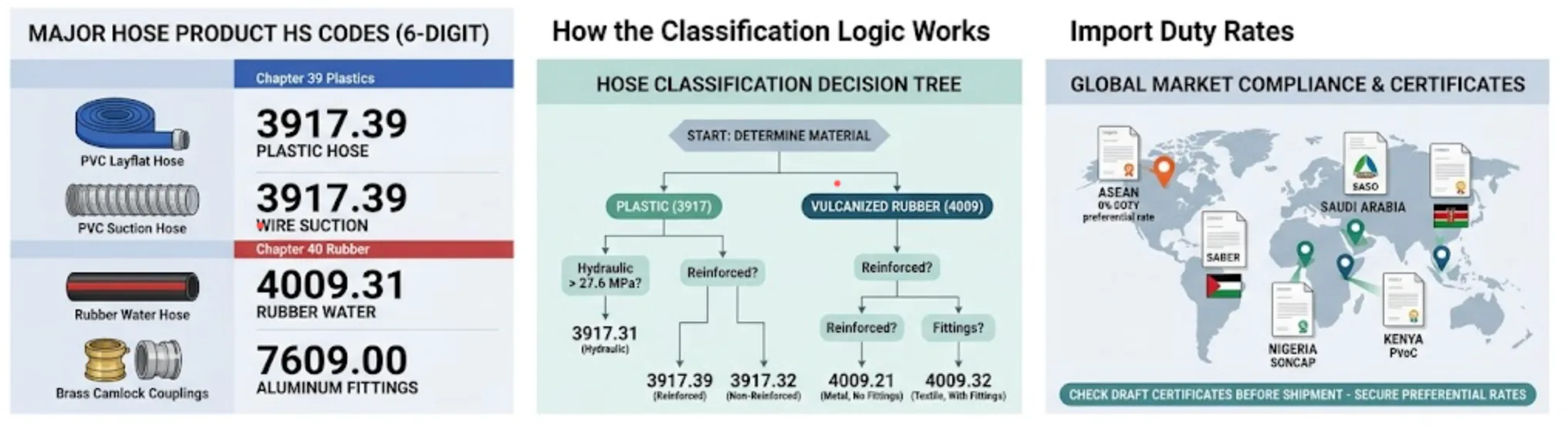
The first six digits of an HS code are standardized worldwide by the World Customs Organization. Digits seven and beyond are national. Here is where hose products from a typical mixed order fall at the six-digit level:
| Product | HS code (6-digit) | Why |
|---|---|---|
| PVC layflat hose (polyester reinforced) | 3917.39 | Flexible plastic hose, reinforced |
| PVC steel wire suction hose | 3917.39 | Flexible plastic hose, combined with steel wire |
| TPU layflat hose | 3917.39 | Polyurethane is also a plastic; reinforcement decides |
| Clear vinyl tubing, no reinforcement | 3917.32 | Flexible plastic hose, not reinforced, no fittings |
| Non-reinforced tubing supplied with fittings | 3917.33 | Same hose, but fittings attached change the subheading |
| Thermoplastic hydraulic hose, burst ≥ 27.6 MPa | 3917.31 | The tariff has a specific line for high-burst-pressure hose |
| Rubber hose, textile reinforced (air/water) | 4009.31 / 4009.32 | Vulcanized rubber, textile reinforcement, without/with fittings |
| Hydraulic rubber hose (steel wire braid) | 4009.21 / 4009.22 | Vulcanized rubber, metal reinforcement, without/with fittings |
| Camlock couplings, aluminum | 7609.00 | Aluminum pipe fittings |
| Camlock couplings, polypropylene | 3917.40 | Plastic fittings |
| Hose clamps, steel | 7326.90 | Articles of iron or steel (most territories) |
Two headings do most of the work: 3917 for plastic hoses and 4009 for rubber hoses. Material decides the chapter; reinforcement and fittings decide the subheading.
How the Classification Logic Works
Customs officers do not classify by product name. They follow a decision tree, and once you know it, most hose classifications become predictable.
Step 1 — What is the material? Plastics (PVC, PU, TPU, PE) go to heading 3917. Vulcanized rubber (NBR, EPDM, SBR blends) goes to heading 4009. This is why a rubber suction hose and a PVC suction hose with identical dimensions and identical applications clear customs under completely different chapters, often at different duty rates.
Step 2 — For plastic hose: is it high-burst hydraulic hose? Subheading 3917.31 covers flexible hose with a minimum burst pressure of 27.6 MPa (4,000 psi). Almost no PVC water hose reaches this; thermoplastic hydraulic hose does. If your test certificates show burst pressure above this threshold, the hose belongs here regardless of what you call it commercially.
Step 3 — Is it reinforced? "Reinforced or otherwise combined with other materials" is the phrase that matters. Polyester yarn inside a layflat hose counts. A steel wire helix counts. A hose that is pure extruded PVC with nothing embedded in the wall does not — that is 3917.32.
Step 4 — Are fittings attached? A plain hose and the same hose cut to length with couplings crimped on are different products to customs. For rubber hose the with/without-fittings split runs through every subheading (4009.11 vs 4009.12, 4009.21 vs 4009.22, and so on). Loose couplings packed in the same container are classified separately as fittings — they do not turn the hose into an "assembly."
One practical note from the exporter side: the HS code your Chinese supplier prints on export documents is the code used for China's export declaration. It is usually correct at six digits, but it does not bind your national customs. We have seen buyers copy a supplier's 10-digit Chinese code onto a US entry — the last four digits meant nothing in the US tariff and the entry bounced back for correction.
Import Duty Rates in Major Markets
The rates below apply to HS 3917.39 (reinforced flexible plastic hose — the code covering layflat and steel wire hose), verified as of July 2026. Duty is normally charged on CIF value, and VAT/GST is then charged on top of (CIF + duty), which first-time importers routinely forget when calculating landed cost.
| Market | Base duty (MFN) | On top of that |
|---|---|---|
| United States | 3.1% (HTS 3917.39.00) | China-origin goods: Section 301 tariff (25%, List 3) plus any China-specific measures in force at entry — these have changed several times since 2025, so check the current stack before quoting a landed price |
| European Union | 6.5% (TARIC 3917 39 00) | Member state VAT, typically 19–23% |
| United Kingdom | 6% (UK Global Tariff) | 20% VAT |
| GCC (Saudi Arabia, UAE, Qatar, etc.) | 5% common external tariff | VAT: 15% Saudi Arabia, 5% UAE |
| India | 10% basic customs duty | Social welfare surcharge (10% of BCD) + 18% IGST — effective burden roughly 31% |
| ASEAN (Vietnam, Indonesia, Philippines…) | Mostly 0% with ACFTA Form E certificate | Local VAT |
| Ecuador | Being phased down under the China–Ecuador FTA (in force since May 2024) | 15% IVA |
| Brazil | Mercosur common tariff, historically 14–16% | IPI, PIS/COFINS and state ICMS — Brazil's cascading taxes roughly double the tax burden; work with a despachante aduaneiro |
Three things worth pulling out of that table:
If you import into ASEAN, the Form E certificate is worth real money. The difference between 0% preferential and the MFN rate is pure margin. But the certificate must be issued before shipment and presented at clearance — more on that below.
US importers of China-origin hose face the most volatile situation. The 3.1% base rate is almost irrelevant next to the China-specific tariffs layered on top, and those have been adjusted repeatedly since 2025. Do not lock in a resale price on a container that is still on the water without confirming the rate that will apply on its entry date.
India applies reference pricing. Indian customs maintains valuation databases for plastic hose by weight. Declared values far below the reference range trigger a valuation query, and the burden of proof lands on the importer. Declare real transaction values.
A note on India specifically: at the eight-digit level, Indian import data shows layflat hose recorded under both 3917.39.90 and 3917.23.90 depending on the customs house. If you import into India, get a broker's opinion in writing rather than relying on what cleared last time.
The Five Mistakes That Actually Get Containers Held
We are not customs brokers, but we prepare export documents for several hundred containers a year and we hear about every clearance problem our customers hit. The same five issues come up again and again.
1. "Pipe" on the invoice when the goods are hose
Rigid PVC pipe and flexible PVC hose sit in different tariff lines, and in some markets rigid PVC pipe from China carries anti-dumping duties that flexible hose does not. An invoice that says "PVC pipe" invites customs to open the container and decide for themselves. Our standard invoice description looks like this:
PVC layflat discharge hose, polyester yarn reinforced, ID 3", working pressure 4 bar, in 100 m rolls — HS 3917.39
Product, material, reinforcement, size, packing, code. An officer reading that line has no reason to stop the shipment.
2. One invoice line for a mixed shipment
A typical first order from us contains layflat hose, aluminum camlocks, and steel clamps. That is three chapters of the tariff: 39, 76, and 73. Each needs its own invoice line with its own value, weight, and code. Lumping them into "hose and accessories — 1 lot" guarantees a query, because customs cannot assess duty on a lot.
3. Claiming a preferential rate without the certificate in hand
Preferential certificates — ACFTA Form E, RCEP certificates of origin, the China–Ecuador FTA certificate — are issued in China around the shipment date. If the certificate has a typo (a wrong invoice number is the classic), or arrives after the goods, most customs administrations make you clear at the MFN rate and claim a refund later. Refund procedures exist everywhere and are fast nowhere. Check the draft certificate against the invoice line by line before the ship sails; it takes ten minutes.
4. Forgetting the conformity program paperwork
Several markets require a conformity assessment before shipment, separate from customs duty entirely: SABER/SASO for Saudi Arabia, SONCAP for Nigeria, PVoC for Kenya. These are shipment-level certificates that must exist before the goods arrive. A hose shipment landing in Mombasa without a PVoC certificate pays for destination inspection plus a penalty, and waits. If your market has such a program, tell your supplier at order time — the factory needs to schedule the inspection before loading.
5. Undervaluation to save duty
It surfaces in every price negotiation eventually: "can you show a lower value on the invoice?" Beyond being illegal in the destination country, it fails on its own terms. Customs systems flag entries by unit price per kilogram, and hose is a commodity with well-known price bands. The outcome is a valuation dispute, full inspection, and your company moved onto the high-risk importer list, which means every future container gets the slow lane. The duty saved on one container is not worth inspections on the next twenty. We decline these requests, and importers who have been through a valuation audit stop asking.
Documents Checklist for a Hose Shipment
What a clean clearance file contains, in the order your broker will ask for it:
- Commercial invoice — descriptions as above, one line per HS code, Incoterm and currency stated
- Packing list — roll counts, net/gross weights and measurements per line, matching the invoice exactly
- Bill of lading — goods description consistent with the invoice (not more detailed, not contradictory)
- Certificate of origin — general CO, or the preferential certificate if you are claiming an FTA rate
- Test reports / MSDS — not always required at clearance, but customs can ask, particularly to verify material (plastic vs rubber) when duty rates differ
- Conformity certificate — SABER, SONCAP, PVoC or equivalent, where applicable
Consistency across documents matters more than any single document. The fastest way to trigger a manual review is an invoice that says 8,400 kg, a packing list that says 8,700 kg, and a bill of lading that says "PVC products."
If you import regularly and want certainty on classification, both the US and the EU offer binding rulings — CBP eRulings in the US and Binding Tariff Information (BTI) in the EU. A ruling takes a few weeks to obtain and then removes classification risk on that product for years. For an importer moving ten containers a year of the same hose, it is one of the best pieces of trade paperwork you can own.
About Sunhose Industrial
Confirm export documents and any requested test reports with the quotation.
Contact us: Email: [email protected] | WhatsApp: +86 180 5604 4070 | Request a Quote →
Related Articles
- Layflat Hose Container Loading Quantity Guide
- How to Choose a PVC Hose Supplier from China: A Guide for Ecuador Importers
- Irrigation Hose Import Guide for South Asia
- What to Pay Attention to When Sourcing Lay Flat Hose
- PVC Layflat Hose — Product Page
Frequently Asked Questions
What is the HS code for PVC layflat hose? 3917.39 at the international six-digit level — flexible plastic tubes, pipes and hoses, reinforced or combined with other materials. The full national code varies: 3917.39.00 in the United States, 3917 39 00 in the EU. The polyester yarn reinforcement is what places layflat hose in .39 rather than .32.
What is the HS code for rubber hose? Heading 4009, subdivided by reinforcement and fittings: 4009.31/32 for textile-reinforced hose (typical air and water hose), 4009.21/22 for metal-reinforced hose (hydraulic hose). The second digit of each pair applies when fittings are attached.
Who is legally responsible for the HS code — the supplier or the importer? The importer of record. The code on the supplier's documents serves China's export declaration and is a reference, not a ruling. If your customs authority reclassifies the goods, the duty difference and any penalty are billed to you, which is why regular importers get a broker's opinion or a binding ruling.
Does shipping couplings and clamps with the hose change the classification? Loose couplings and clamps in the same container are classified separately: aluminum camlocks under 7609.00, polypropylene camlocks under 3917.40, steel clamps under 7326.90. Only fittings actually attached to the hose change the hose's own subheading (for example 4009.31 → 4009.32).
Is import duty calculated on FOB or CIF value? Most countries assess duty on CIF value (goods + freight + insurance), then charge VAT or GST on CIF plus duty. The United States is the notable exception — US duty is assessed on the transaction value of the goods, essentially FOB.
How can I know the exact duty before I order? Give your customs broker the six-digit code, the country of origin, and a product description including material and reinforcement, and ask for a landed cost calculation. For the US you can check base rates free at hts.usitc.gov; for the EU, the TARIC database. If you plan repeat shipments, request a binding ruling — it is free in the US and inexpensive in the EU.