Air Compressor Hose: Complete Selection Guide
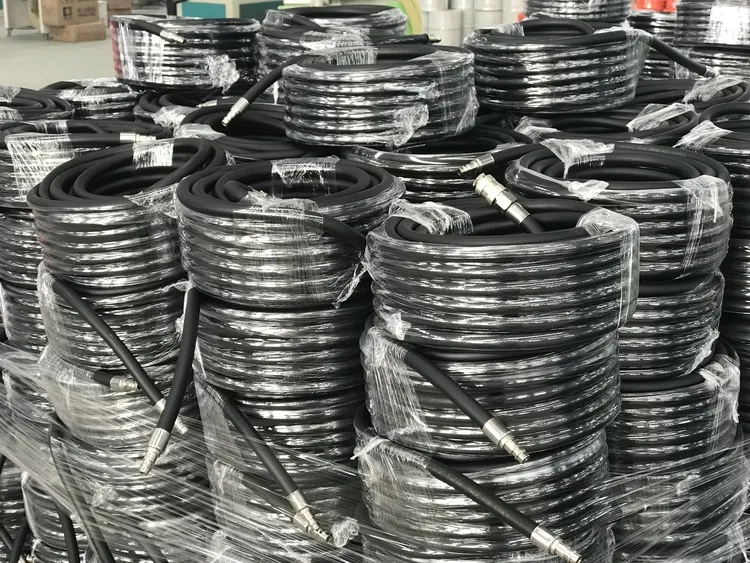
An air compressor hose is the flexible, reinforced line that carries compressed air from a compressor to a pneumatic tool. It is the cheapest component in the system and the one most likely to cost you performance — an undersized hose can strip 20 psi or more from a tool rated at 90 psi, and no amount of compressor capacity will get it back.
This guide covers the four decisions that actually matter: internal diameter, material, pressure rating, and fittings.
Size the hose to the tool, not to the compressor
Air hoses are measured by internal diameter (ID), not outside diameter. Two hoses that look identical from the outside can differ by a full size internally depending on wall thickness. Standard imperial sizes are 1/4", 3/8" and 1/2"; the metric equivalents sold in Europe and Asia are 6 mm, 8 mm and 10 mm.
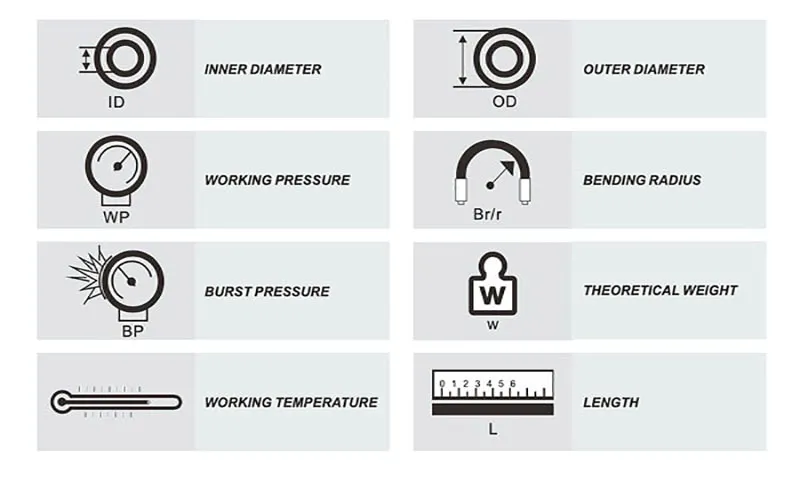 Air hose inner diameter sizes
The rule most buyers get wrong: hose diameter is dictated by the air consumption of the tool, and the penalty grows with hose length. A 1/4" hose is fine for a nailer and useless for a sander. Approximate pressure loss over a 50 ft (15 m) hose at 90 psi inlet:
| Tool demand | 1/4" ID | 3/8" ID | 1/2" ID |
|---|---|---|---|
| 5 CFM | ~3 psi | under 1 psi | negligible |
| 10 CFM | ~11 psi | ~2 psi | under 1 psi |
| 20 CFM | unusable | ~7 psi | ~2 psi |
| 40 CFM | unusable | unusable | ~7 psi |
Match that against what tools actually draw at 90 psi:
| Tool | Typical air demand |
|---|---|
| Framing nailer | 2–3 CFM (intermittent) |
| 1/2" impact wrench | 4–5 CFM |
| Die grinder | 4–6 CFM |
| Random orbital sander | 6–9 CFM |
| HVLP spray gun | 12–14 CFM |
| Sandblaster | 15–40 CFM |
So: 1/4" for nailers and tyre inflation on short runs, 3/8" as the general-purpose default, 1/2" for sanders, spray guns, blasting, or any run over 100 ft. If you have to extend with couplers, remember the losses add — two 50 ft hoses joined behave worse than one 100 ft hose, because every coupling is a restriction.
 Inner diameter and length of hose
Material: what changes and what it costs
The material sets weight, cold-weather behaviour, service life and price. Everything else is secondary.
| PVC | RUBBER | POLYURETHANE (PU) | HYBRID | |
|---|---|---|---|---|
| Durability & flexibility | Flexible, kinks a little | Naturally abrasion resistant. Lies flat and doesn't kink. Very durable. | Less flexible, but makes excellent recoil hoses. | Lies flat like rubber, bends like PVC. Good kink recovery. |
| Weight | Very light — roughly 1/4 the weight of rubber | The heaviest type of air hose | Very light, easy to transport | Light; close to PVC |
| Cold weather | Poor. Stiffens around −5 °C (23 °F). | Mediocre. Usable to about −20 °C (−4 °F). | Excellent. Stays flexible to about −30 °C (−22 °F). | Good. Typically −25 °C (−13 °F). |
| Application | Medium-duty. Preferred over rubber purely for the reduced weight. | Regular to heavy-duty: industrial, agricultural, professional, home. | Hard-wearing, useful at higher pressures. | Professional daily use where drag and weight matter. |
| Price | Lowest | Dependable mid-budget | Highest of the three base materials | Above PVC, below rubber |
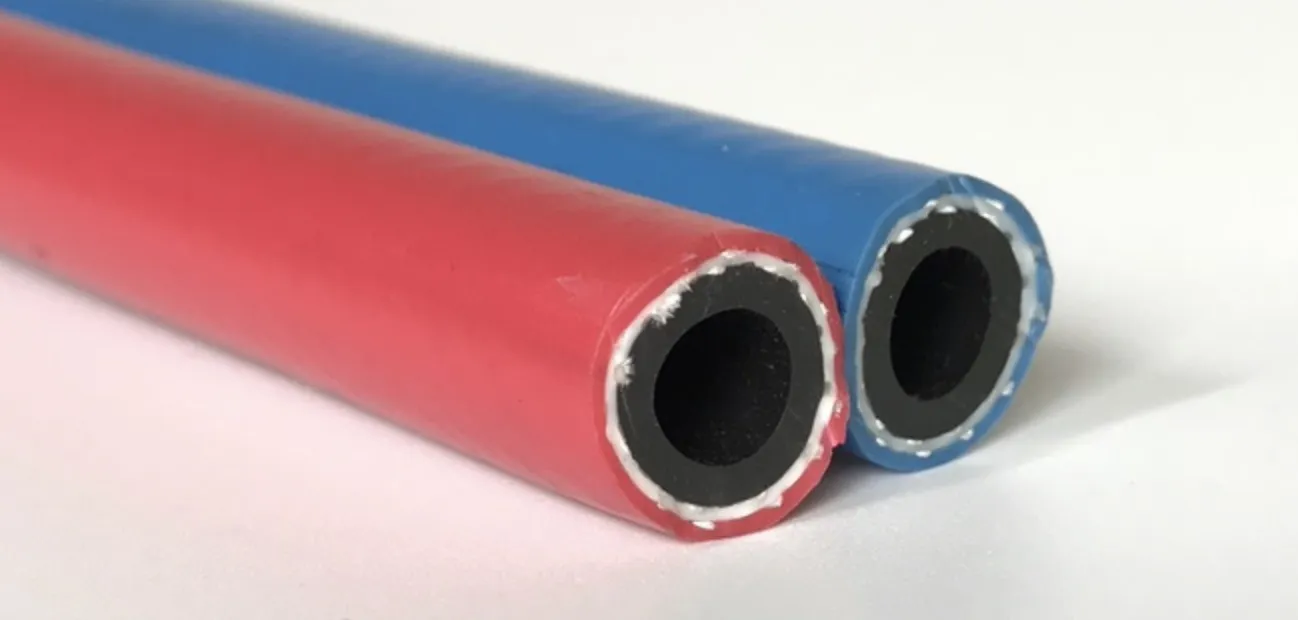 PVC, rubber and hybrid compressor air hoses
A few specifics worth knowing before you specify:
- PVC air hose is extruded from suspension-grade PVC resin (SG-5 or similar) over a fibre-braid reinforcement. It is stable, friction-resistant and cheap. Its real weakness is cold: below freezing it goes stiff and takes a set, and a hose dragged around a yard in winter will eventually crack at the flex points.
- Rubber air hose is usually NBR (nitrile) over a textile braid, typically rated 150–300 psi working pressure. It stays flexible in cold, resists abrasion and oil, and lies flat instead of coiling up underfoot. It is also three to four times the weight of PVC, which is why most professionals stop buying it for long runs.
- Polyurethane resists kinks and abrasion better than PVC at similar weight, and is the standard choice for recoil hoses. It costs more and is stiffer.
- Hybrid air hose is a layered construction — a PVC or polymer core with rubber-like outer compounds — built specifically to remove the weight/cold trade-off. See our hybrid air hose guide and the hybrid vs rubber comparison for where it wins and where it doesn't.
- Nylon appears in compact coil hoses. It is the most durable of the group and the least flexible — a niche choice, not a general-purpose one.
 Working temperature range
PVC or rubber, in one line
Buy PVC if the hose stays indoors or in a warm climate and weight matters. Buy rubber if it will be dragged over concrete, used below freezing, or exposed to oil. Buy hybrid if both are true.
Working pressure, burst pressure and the safety factor
Two ratings appear on every spec sheet, and they are not interchangeable:
- Working pressure (WP) — the continuous pressure the hose is designed to carry in service. Most air compressor hoses are 200–300 psi.
- Burst pressure (BP) — the pressure at which the hose fails in a destructive test. It is a laboratory figure, never an operating limit.
Industrial air hose is normally built to a 3:1 or 4:1 ratio of burst to working pressure. A hose quoted as "300 psi burst" with no working-pressure figure is being sold on the wrong number — its actual WP may be only 75–100 psi. Always specify WP, and choose a hose whose WP exceeds your compressor's maximum output, not its regulated setting.
Compressed air also stores energy. A hose that fails under pressure whips, and the fitting on the end of it becomes a projectile. That is what the safety factor is for, and why worn hose gets replaced rather than patched.
Fittings and connectors
Fittings join hose to compressor, hose to tool, and hose to hose. They are also where most leaks start. The common thread standards:
| Standard | Full name | Notes |
|---|---|---|
| BSPT | British Standard Pipe Taper | Used internationally despite the name. Male = BSPM, female = BSPF. Common in 1/4". |
| NPT | National Pipe Thread | US standard, steeper thread angle than BSPT. Common in 3/8". |
| PCL | Pneumatic Components Ltd | Collar-operated coupling, popular in fixed workshop installations. |
BSPT and NPT will thread together but will not seal. The flank angles differ (55° versus 60°) and the pitch does not match. This is the single most common cause of a "faulty" new hose — the threads engage, the assembly feels tight, and it leaks steadily. Confirm the standard before ordering fittings for an export market.
Quick-release couplings use O-rings rather than tapered threads, let you change tools in seconds, and twist the hose less in use. Fitting bodies come in plastic, brass, aluminium and steel — use brass or steel for anything that gets stepped on.
Coiled and retractable hoses normally ship with male and female connectors already fitted at each end.
Replacing a worn fitting
- Cut off the old connector square.
- Measure the hose internal diameter.
- Source a replacement fitting of matching size and thread standard.
- Attach with a ferrule, clamp or wrench, as the fitting type requires.
Where compressor hose gets used
- Construction — nail guns, jackhammers, impact wrenches.
- Automotive workshops — air ratchets, impact wrenches, spray guns, tyre inflation.
- Manufacturing — sanders, grinders, drills, and air-actuated assembly equipment.
- Agriculture and mining — where abrasion and cold push the choice toward rubber or hybrid.
Maintenance that actually extends service life
- Inspect before use. Replace on any sign of cracking, bulging or exposed reinforcement — these are terminal, not cosmetic.
- Drain moisture after use. Condensate sitting in the line corrodes fittings and carries water into tools.
- Store on a reel, out of direct sunlight. UV degrades PVC and rubber alike, and coiling by hand builds in the kinks that later become cracks.
- Keep it off hot surfaces and away from solvents.
- Check couplings periodically. A slow leak at a fitting makes the compressor cycle constantly, and costs more in electricity than the fitting costs to replace.
Safety basics
- Wear eye protection when working with pneumatic tools.
- Never look into a pressurised line or point one at anyone.
- Fit relief valves where over-pressurisation is possible.
- Route and anchor hose so it is not a trip hazard and cannot be pulled into moving machinery.
FAQ
How often should an air compressor hose be replaced? Inspect before every use and replace on visible damage. In normal service, plan on 3–5 years; hoses that live outdoors or in cold climates fail sooner.
Can I join two hoses to get more length? Yes, with a coupler — but each joint adds a restriction and pressure loss compounds. One long hose of the correct diameter always outperforms two short ones joined.
Are all air hoses interchangeable? No. They differ in internal diameter, material, working pressure and thread standard. A hose that suits a nailer will starve a sander.
Can a damaged air hose be repaired? A fitting can be replaced. A hose with a split, bulge or exposed braid should be taken out of service — repair kits do not restore the reinforcement, and the reinforcement is what contains the pressure.
Can I use a water hose for compressed air? No. Garden and water hose is not built for the pressure or the failure mode of compressed air, and it will not fail safely.
What size air hose is best for general workshop use? 3/8" ID. It handles almost every hand tool up to about 15 CFM with negligible loss, and is far easier to manage than 1/2".
Sunhose manufactures PVC air hose, rubber air and water hose and hybrid air hose for distributors and OEM buyers, in custom lengths, colours and fitting standards. Send us your specification and we will quote against it.