Hydraulic Hose Leak Inspection and Replacement Guide
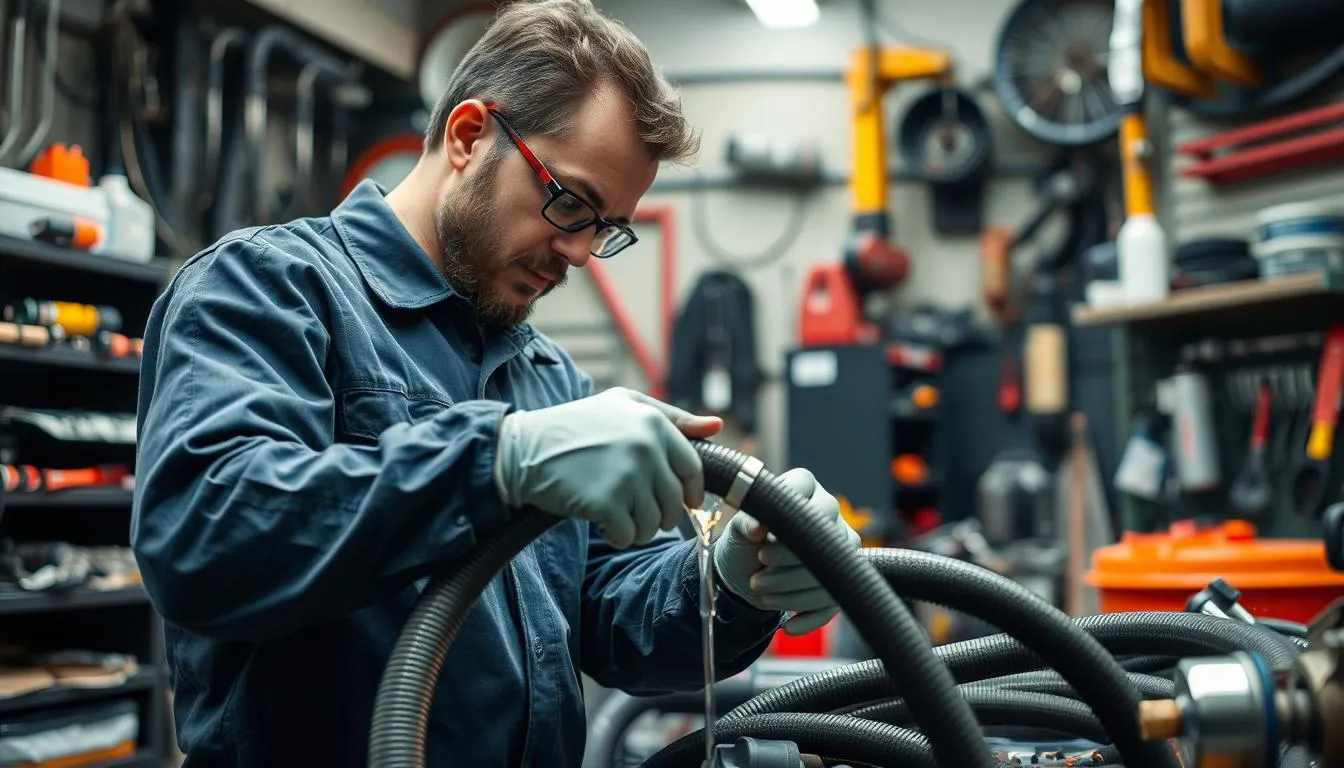
A leaking hydraulic hose is a safety issue, not a routine patching job. Pressurized fluid can escape through a pinhole as a fine jet that is difficult to see and can penetrate skin. Stop the machine, isolate its energy sources, release stored pressure according to the equipment manufacturer's procedure, and keep people away from the suspected leak area.
Never search for a leak with your hand or another part of your body. If hydraulic fluid penetrates the skin, seek emergency medical treatment immediately, even if the wound appears small.
Repair the connection or replace the assembly?
First identify where the fluid originates after the system has been made safe. A loose port connection, damaged adapter seal, and failed hose assembly require different corrective actions.
Replace the complete hose assembly when inspection finds any of the following:
- Fluid leaking through the hose cover or at the crimped fitting
- Exposed reinforcement, cuts, severe abrasion, blistering, or a soft cover
- A kinked, crushed, flattened, or twisted section
- A hard, heat-cracked, or charred cover
- Corroded, cracked, bent, or slipping fittings
- Evidence that the assembly has pulled out of the ferrule
Do not patch a failed high-pressure hose or reuse a field-detached fitting unless the fitting system is specifically designed and documented for that procedure. A replacement assembly must use a hose, coupling, ferrule, and crimp specification validated as a compatible system by the assembly manufacturer.
Safe inspection sequence
- Park and secure the equipment according to its service manual.
- Lower supported loads and isolate electrical, mechanical, pneumatic, and hydraulic energy.
- Relieve trapped pressure. Switching off the pump alone may leave pressure behind check valves or accumulators.
- Allow hot components and fluid to cool.
- Wear the personal protective equipment required by the equipment and site procedures.
- Inspect from a safe position using adequate lighting. Never use fingers to locate a pinhole leak.
- Mark both hose ends, routing points, guards, and clamp positions before removal.
- Cap open ports to prevent contamination entering the hydraulic system.
The equipment manufacturer's service instructions take priority over a general guide. Work on high-pressure systems should be performed by trained personnel using the correct isolation and test equipment.
Information needed to order the correct replacement
Sending only the old hose length is not enough. Record the following before requesting a replacement or OEM quotation:
| Requirement | What to record |
|---|---|
| Hose size | Inside diameter or dash size |
| Working pressure | Maximum system working pressure, including known surges |
| Temperature | Fluid and ambient temperature range |
| Fluid | Hydraulic oil or other conveyed fluid, including concentration where relevant |
| End fittings | Thread standard, size, gender, sealing style, and fitting orientation |
| Length | Overall assembly length using the supplier's stated measurement method |
| Routing | Minimum bend radius, movement, abrasion points, and nearby heat sources |
| Environment | Ozone, UV, chemicals, salt spray, mining debris, or outdoor exposure |
| Compliance | Applicable SAE, EN, ISO, OEM, or customer specification |
| Quantity | Trial quantity, annual demand, packaging, and traceability needs |
The rated working pressure of the complete assembly is limited by its lowest-rated compatible component. A higher-pressure hose does not compensate for a lower-rated fitting or adapter.
Check routing before installing the new hose
Premature failures often repeat because the original routing problem remains. Before installation, check for:
- Bends tighter than the hose manufacturer's minimum bend radius
- A bend beginning immediately behind the fitting
- Twisting caused by misaligned fitting angles
- Contact with sharp edges, moving parts, or hot surfaces
- Insufficient slack for machine movement and pressure-related length change
- Missing clamps, abrasion sleeves, guards, or whip restraints required by the application
Use angled fittings or adapters when they create a cleaner route. Do not force the hose into alignment by twisting the assembly.
Installation and controlled recommissioning
Keep the new assembly and open ports clean. Confirm the fitting orientation before tightening connections, install guards and clamps in their original positions, and use the equipment manufacturer's torque and commissioning instructions.
During the functional test, keep personnel outside the potential failure zone. Bring the system up in a controlled manner and check for abnormal movement, rubbing, twisting, and leakage without approaching a pressurized line. Shut down and depressurize before correcting any problem.
Inspection intervals and replacement records
There is no single safe replacement interval for every hydraulic hose. Inspection frequency depends on pressure cycles, temperature, routing, abrasion, fluid compatibility, environment, the consequence of failure, and the equipment manufacturer's requirements.
Maintain a record containing the assembly identifier, installation date, hose and fitting specification, inspection findings, failure location, and replacement reason. Repeated failures in the same position usually indicate a selection, routing, contamination, pressure-surge, or installation problem that should be corrected before another assembly is installed.
What to send Sunhose for an OEM quotation
For factory-made hydraulic hose or bulk hose procurement, provide:
- Hose standard and construction, such as SAE 100R1AT/EN 853 1SN, SAE 100R2AT/EN 853 2SN, EN 856 4SP, or EN 856 4SH
- Dash size and required working pressure
- Fluid and temperature range
- Assembly length and fitting drawings, or bulk-hose coil length
- Required test reports, marking, packaging, and traceability
- Estimated order quantity and destination country
See the SAE 100R1AT / EN 853 1SN hose, SAE 100R2AT / EN 853 2SN hose, EN 856 4SP hose, and EN 856 4SH hose product pages for available constructions.
Technical references
- SAE J1273 — Recommended Practices for Hydraulic Hose Assemblies
- Parker Hose Products Division safety guide
- Gates hydraulic hose and couplings catalogue safety guidance
These references cover general selection, installation, inspection, maintenance, and safety practices. Always apply the equipment manufacturer’s instructions and the requirements for the specific machine and jurisdiction.