PVC Layflat Discharge Hose for Agriculture in Africa: A Complete Buyer's Guide
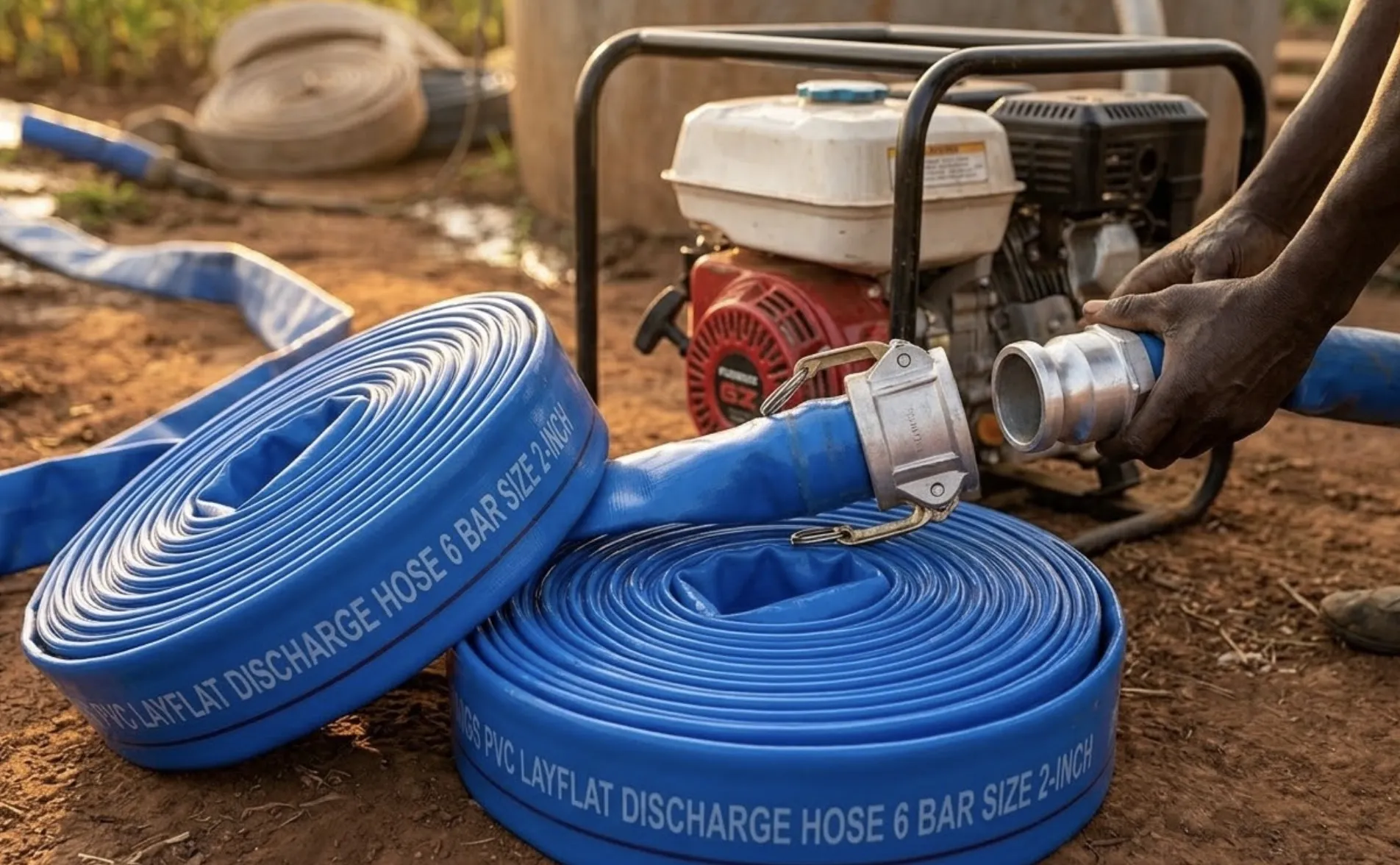
PVC Layflat Discharge Hose for Agriculture in Africa: A Complete Buyer's Guide
Introduction
For farmers and agricultural equipment distributors across Nigeria, Kenya, Ethiopia, Tanzania, and South Africa, the PVC layflat discharge hose has become one of the most critical — and most frequently replaced — components in any pump-based irrigation or drainage system.
The right hose moves water from boreholes, rivers, and water pans to fields efficiently, withstands the heat and UV conditions of sub-Saharan Africa, and lasts multiple growing seasons. The wrong hose bursts under pressure, cracks in dry-season heat, or fails at the coupling joint mid-irrigation — costing farmers both water and yield at exactly the wrong time.
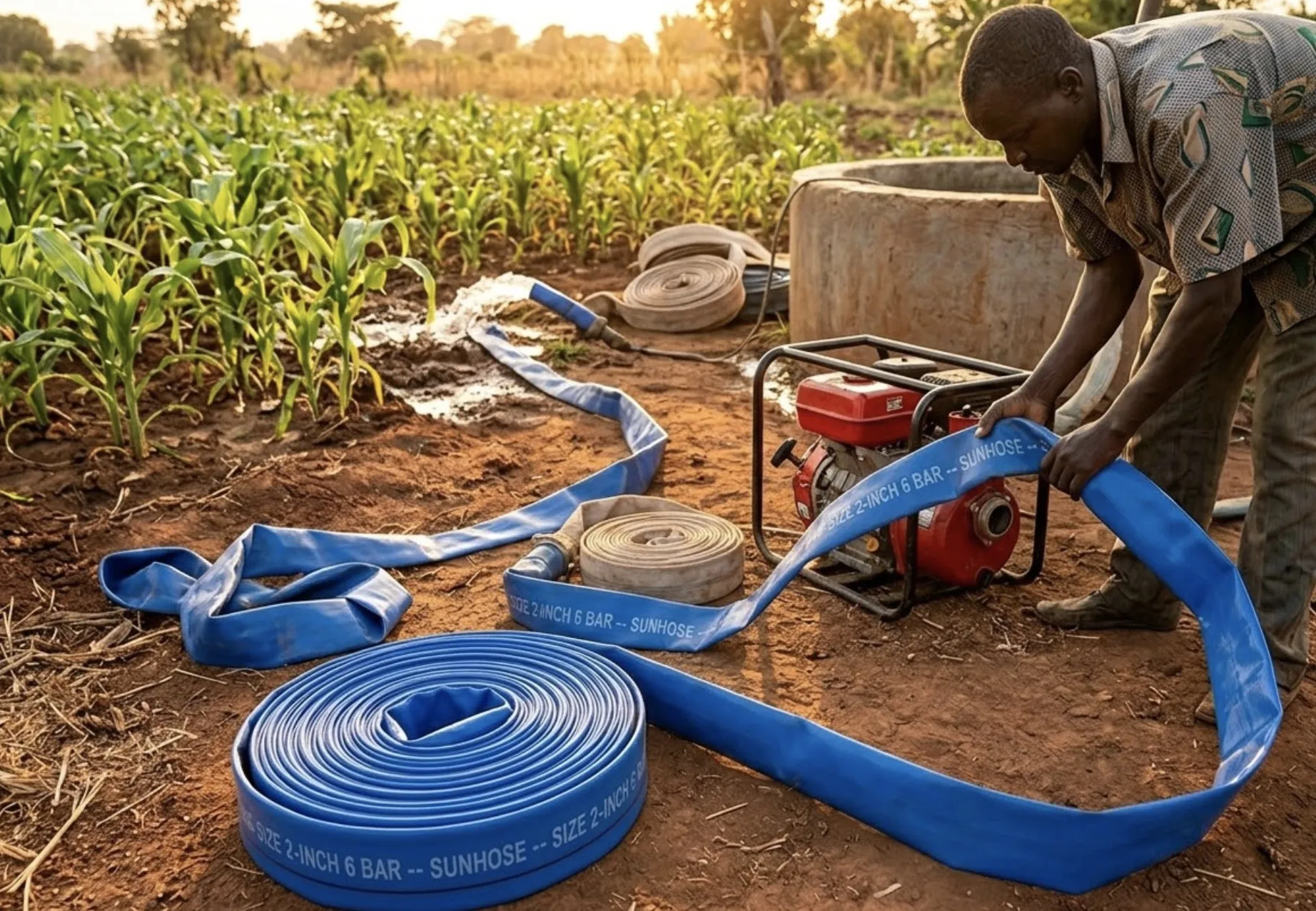 2inch layflat hose
This guide is written for agricultural input distributors, irrigation equipment importers, and farm managers across Africa who are evaluating PVC layflat hose options — including how to source directly from Chinese manufacturers at competitive FOB pricing.
Why PVC Layflat Discharge Hose is the Preferred Choice for African Agriculture
Sub-Saharan Africa has only 4% of its agricultural land under irrigation, yet the continent holds enormous untapped irrigation potential. Africa currently spends more than USD 35 billion annually on food imports — a figure projected to rise if productivity gaps are not addressed. Closing the irrigation gap could transform productivity, enabling multiple cropping seasons and boosting yields two to three times over.
Against this backdrop, low-cost, practical irrigation infrastructure — particularly pump-connected layflat hose systems — is expanding rapidly across smallholder farms in West Africa, East Africa, and Southern Africa.
PVC layflat hose is the dominant choice for agricultural water discharge in Africa for four practical reasons:
Cost efficiency. PVC layflat hose costs significantly less per meter than rigid PVC pipe or rubber discharge hose, making it accessible for small and medium-scale farms operating on tight input budgets.
Portability. When empty, the hose collapses flat and rolls into a compact coil. A 100-meter roll of 2-inch layflat hose weighs approximately 22–32 kg — light enough for one person to carry and reposition between fields or seasons.
Pump compatibility. Layflat hose connects directly to the outlet of petrol, diesel, or solar-powered centrifugal pumps using standard camlock or BSP fittings — no specialized equipment or plumbing skills required.
Scalability. Hose lengths can be connected end-to-end using standard couplings to cover distances of 200 meters, 500 meters, or more — essential for farms where water sources are far from field plots.
Choosing the Right Size: Diameter and Pressure Rating
Selecting the wrong diameter is the most common and costly mistake. Undersized hose creates excessive back-pressure on the pump, reducing flow rate and accelerating pump wear. Oversized hose reduces water velocity, leading to uneven distribution across field lengths.
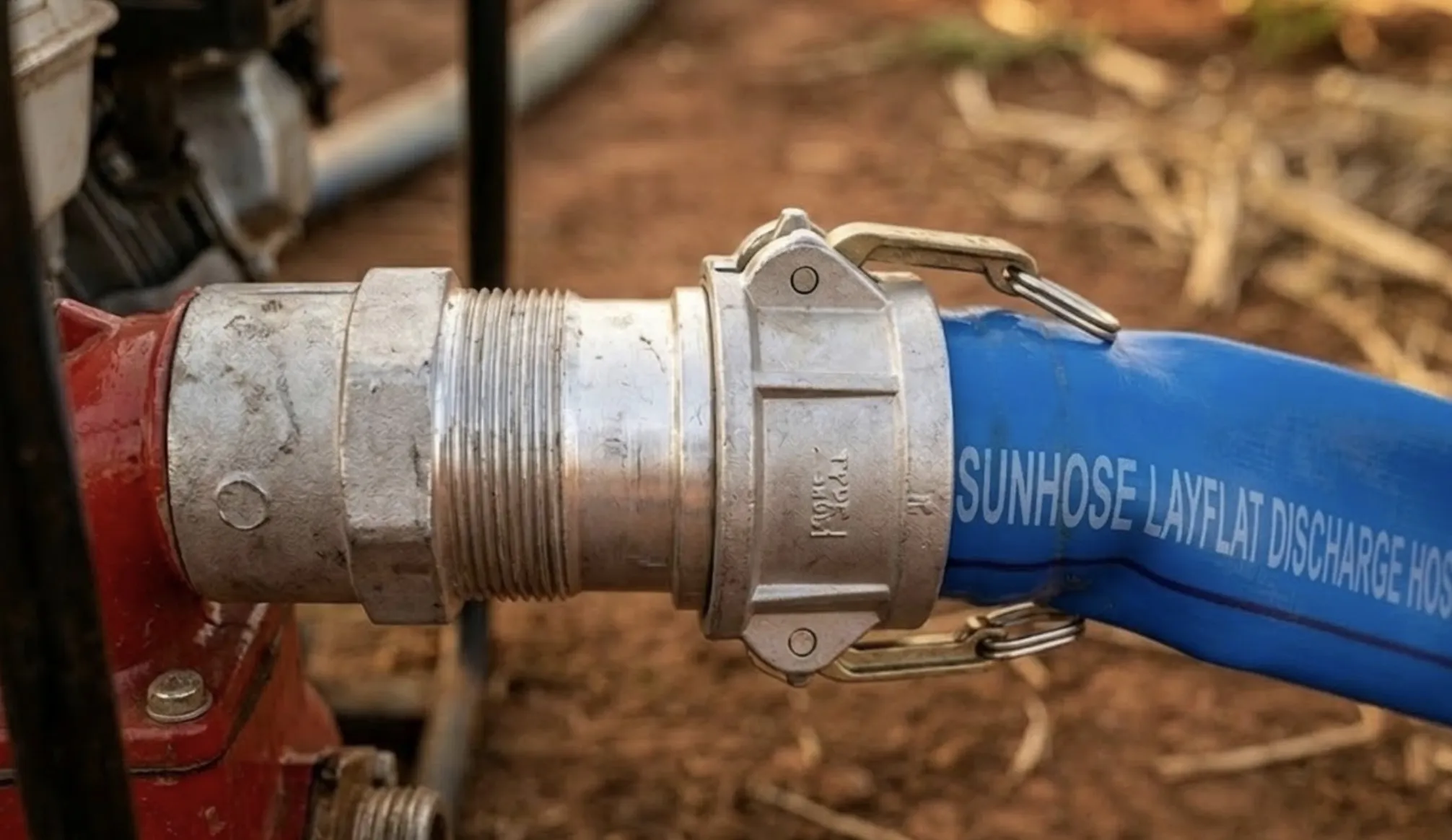 Layflat hose with pump
Recommended Sizes by Application
| Application | Recommended ID | Working Pressure | Typical Roll Length |
|---|---|---|---|
| Smallholder plot irrigation (≤1 ha) | 1.5 inch (38 mm) | 4–6 bar | 50 m or 100 m |
| Medium farm water transfer | 2 inch (51 mm) | 6–8 bar | 100 m |
| Large farm main discharge line | 3 inch (76 mm) | 6–8 bar | 100 m |
| Borehole to storage tank transfer | 4 inch (102 mm) | 8–10 bar | 100 m |
| Flood drainage / construction dewatering | 6–8 inch (152–203mm) | 8–12 bar | 100 m |
Rule of thumb: Match the hose inner diameter to the pump outlet diameter. A 2-inch pump outlet requires a 2-inch hose. Reducing or upsizing at the connection point creates pressure drop and fitting stress.
Understanding Pressure Ratings
PVC layflat hose is rated by working pressure (WP) and burst pressure (BP). A well-manufactured hose should have a burst pressure at least 3× the working pressure.
For agricultural pump systems in Africa, the most common working pressures are:
4–6 bar: Suitable for low-head centrifugal pumps, gravity-fed systems, and borehole hand pumps
6–8 bar: Standard for petrol/diesel engine-driven centrifugal pumps at 50–100 meter discharge distances
8–12 bar: Required for high-lift applications, multi-stage pumps, or long-distance water transfer exceeding 300 meters
Always specify working pressure — not burst pressure — when requesting a quotation from a manufacturer.
UV Resistance and Heat Tolerance: Critical Requirements for Sub-Saharan Africa
This is where many imported hoses fail prematurely in African conditions.
Standard PVC hose formulated for European or temperate climates often contains minimal UV stabilizer package, because extended outdoor UV exposure is not assumed. In Nigeria, Kenya, Ethiopia, and Tanzania, hoses are routinely left deployed in direct sun for weeks or months at temperatures exceeding 40°C. Without adequate UV protection, the PVC compound undergoes photo-oxidative degradation — the outer layer chalks, hardens, and becomes brittle, leading to surface cracks and eventual failure at the reinforcement layer.
What to specify when ordering for African markets:
UV stabilizer additive: Ask the manufacturer to confirm that their PVC compound includes a UV stabilizer package (typically HALS — Hindered Amine Light Stabilizers). A quality manufacturer will be able to name the stabilizer and confirm its loading percentage.
Carbon black or titanium dioxide (TiO₂) content: Black or dark-colored hoses incorporate carbon black as a UV shield. For colored hoses (blue, red, green), TiO₂ or other UV-blocking pigments must compensate.
Outdoor storage test data: Ask whether the hose has been tested under accelerated UV weathering (ASTM G154 or ISO 4892-2). A hose rated for 2,000+ hours of UV exposure is appropriate for African field conditions.
Temperature rating: The hose should be rated for continuous use at temperatures from −5°C to +60°C. Many African hoses experience pavement temperatures exceeding 55°C when dragged across sun-exposed soil.
Wall Thickness: Why It Matters More in Africa Than Anywhere Else
PVC layflat hose in Africa is used across agriculture, construction, mining, and flood control — often in abrasive conditions involving gravel, soil, and rough terrain.
African agricultural conditions are harder on hose walls than most other markets:
Hoses are dragged across rocky, laterite, or sun-baked clay soils
Sharp grass stubble and crop residue abrades the outer surface during movement
Hoses are sometimes stored coiled in direct heat, creating pressure points at the fold
Minimum wall thickness recommendations for Africa:
| Hose Diameter | Minimum Wall Thickness (Africa) | Standard Export Minimum |
|---|---|---|
| 1.5 inch | 2.0 mm | 1.6 mm |
| 2 inch | 2.2 mm | 1.8 mm |
| 3 inch | 2.5 mm | 2.0 mm |
| 4 inch | 3.0 mm | 2.5 mm |
Ask your supplier to confirm the nominal wall thickness and tolerance in the quotation document. A tolerance of ±0.2 mm is acceptable; wider tolerance indicates inconsistent extrusion quality.
Reinforcement Layer: Polyester Yarn Specification
The reinforcement layer — a woven or braided polyester yarn mesh between the inner tube and outer cover — determines burst pressure and kink resistance. For agricultural discharge hose, the reinforcement must be circular woven (not braided), as circular weaving provides more even pressure distribution across the hose diameter.
Key reinforcement specifications to request:
Yarn denier: Higher denier = stronger reinforcement. Standard agricultural hose uses 1,000–1,500 denier polyester yarn. Heavy-duty hose for high-pressure applications uses 1,500–2,000 denier.
Weave angle: Typically 54.7° (the "magic angle") for optimal balance of axial strength and hoop strength under internal pressure.
Number of yarn layers: Single-layer reinforcement is standard for 4–8 bar hose. Dual-layer reinforcement is required for 8–12 bar.
A manufacturer who cannot specify yarn denier and weave count is likely outsourcing production or reselling — they do not control the manufacturing process.
Fittings and Couplings for Africa: What Works in the Field
The coupling joint is the most common failure point in African field conditions. Hoses that perform well under pressure fail at the connection when:
Fittings are the wrong type for field conditions
Couplings are over-tightened and damage the hose wall
Incompatible thread standards are mixed (BSP vs NPT vs metric)
Recommended coupling types for African agricultural use:
Camlock (cam and groove) couplings — the most practical choice for African farm conditions. Male and female halves connect with a quarter-turn and spring-loaded arms. No tools required. Available in aluminum (lightest, most common), brass (chemical resistant), and stainless steel (longest life). Camlock Type C (female coupler) and Type E (male adapter) are the most used in Africa.
Bauer / quick-release couplings — popular in East Africa for larger diameter hose (3–6 inch). Used for connecting layflat hose to suction hose, pump outlets, and field distribution lines. The lever-lock system seals reliably even in muddy conditions.
BSP threaded fittings — required when connecting to standard British-thread pump outlets. Most Asian and African pump brands use BSP threading. Confirm thread standard with your pump supplier before ordering fittings.
Sizing note: When ordering hose from China, always specify coupling type and thread standard explicitly. Chinese manufacturers supply for global markets and will provide whichever standard you specify — but they cannot guess your local requirements.
How to Import PVC Layflat Hose Directly from China to Africa
Importing directly from a Chinese manufacturer rather than buying from local distributors typically reduces per-meter cost by 30–50%, depending on volume. Here is the standard import framework for African buyers:
Minimum Order Quantities
Most Chinese layflat hose factories set a minimum order of 1,000 kg per specification (diameter + pressure rating). For mixed orders combining multiple sizes, many factories will consolidate to reach the MOQ threshold.
Prices vary by PVC resin cost, order volume, and UV additive specification. Always request a formal quotation with specifications documented.
Shipping Routes to Africa
| Destination Port | Nearest Chinese Port | Sea Transit Time |
|---|---|---|
| Lagos, Nigeria | Qingdao / Shanghai | 22–28 days |
| Mombasa, Kenya | Qingdao / Ningbo | 18–24 days |
| Dar es Salaam, Tanzania | Qingdao / Shanghai | 20–26 days |
| Durban, South Africa | Qingdao / Ningbo | 20–28 days |
| Tema, Ghana | Shanghai | 25–30 days |
Layflat hose ships well in 20-foot or 40-foot FCL (Full Container Load) containers. A 20-foot container typically holds 75,000–95,000 meters of 2-inch hose (depending on coil diameter and packing). For smaller initial orders, LCL (Less than Container Load) consolidation is available at most Chinese ports.
Payment Terms
Standard terms for new supplier relationships: 30% T/T deposit before production, 70% T/T balance before shipment (against copy of Bill of Lading). For established relationships or orders above USD 80,000, Letter of Credit (L/C at sight) is also accepted by most factories.
Quality Inspection Before Shipment: Protecting Your Order
For orders pre-shipment inspection . A standard inspection covers:
Wall thickness measurement (digital caliper, 5 sample points per roll)
Hydrostatic pressure test at 1.5× working pressure for 5 minutes
Visual check for surface defects, color uniformity, and coupling seating
Carton marking and quantity verification
The cost of a pre-shipment inspection (typically USD 300–650 per inspection day) is insignificant relative to the cost of receiving a full container of substandard hose in Lagos or Mombasa.
Common Questions from African Buyers
What color of layflat hose is recommended for African farms?
Blue is the most common color for agricultural water discharge across Africa and is widely recognized as a water-service hose. Red hose is often associated with firefighting applications. For UV resistance, darker colors (black or dark blue) provide better UV shielding than light blue — if UV performance is the priority, specify dark blue or black with confirmed UV stabilizer package.
Can PVC layflat hose be used for pesticide or fertilizer solution transfer?
Standard PVC layflat hose is compatible with diluted fertilizer solutions and most common agricultural pesticides at working concentrations. However, for concentrated chemical transfer or herbicide main-line applications, request a chemical resistance chart from the manufacturer and verify compatibility for your specific formulation. For concentrated acids or solvents, rubber or UHMWPE-lined hose is more appropriate.
How long should a quality PVC layflat hose last in African field conditions?
With proper storage (shaded, rolled, off the ground when not in use) and a quality UV-stabilized compound, a well-manufactured PVC layflat hose should deliver 3–5 growing seasons in African conditions. Hoses left deployed in direct sun year-round, dragged frequently over abrasive surfaces, or stored in high heat without shade typically last 1–2 seasons regardless of initial quality.
What is the difference between layflat hose and suction hose?
Layflat discharge hose is designed for pressure applications — moving water away from a pump outlet. It cannot withstand vacuum and will collapse under suction. Suction hose has a rigid spiral reinforcement (typically steel wire or PVC helix) that holds the hose open under negative pressure — it is used on the inlet side of the pump, drawing water from the source. A complete pump installation requires both: suction hose from source to pump, and layflat discharge hose from pump to field.
Can I get custom colors or branding for bulk orders?
Most Chinese layflat hose manufacturers can produce custom colors and print distributor names or logos on the hose outer surface for orders of 10,000 meters or more. Lead time for custom color or printing is typically 10–30 days longer than standard production.
What certifications should I look for when buying from China for African markets?
At minimum, request ISO 9001:2015 (quality management system) and REACH compliance (confirming the hose does not contain restricted chemicals under European regulation — also referenced in increasing numbers of African procurement standards). For hoses used in drinking water or food-related applications, request NSF 61 or FDA compliance documentation.
Summary: Africa Agricultural Layflat Hose Specification Checklist
Before confirming any order, verify the following with your supplier:
Inner diameter matches pump outlet size
Working pressure rating exceeds maximum pump output pressure by at least 20%
Wall thickness confirmed in writing (not nominal — actual production spec)
UV stabilizer confirmed in PVC compound formulation
Temperature rating covers −5°C to +60°C minimum
Polyester yarn denier and weave type specified
Coupling type and thread standard confirmed (camlock / Bauer / BSP)
Coil length per roll confirmed (50 m or 100 m)
ISO 9001 certificate verified on issuing body website